
Guitar Chords: The Complete Guide for Adults
Updated April 7, 2026
Every song you’ve ever loved started with guitar chords. Chords are a key component of music. They are the building blocks that create the emotional landscape a melody sits inside. The more chord types you know and the more fluently you can move between them, the more musical and versatile your rhythm playing becomes.
This guide walks through every chord type you’ll encounter as a guitarist, from your first open chords through advanced jazz voicings. It’s organized by difficulty so you can start where you are and progress naturally. For how chords fit into the complete rhythm guitar picture, see our Ultimate Guide to Rhythm Guitar.

Open Chords: Where It All Begins
Open chords are the first shapes every guitarist learns, and they’re anything but basic. Some of the most beloved songs in history use nothing more than three or four open chords played well. The major shapes, C, A, G, E, and D, give songs a bright, happy quality. The minor shapes, Am, Em, and Dm, add darkness and emotional depth. Below is how to play them:
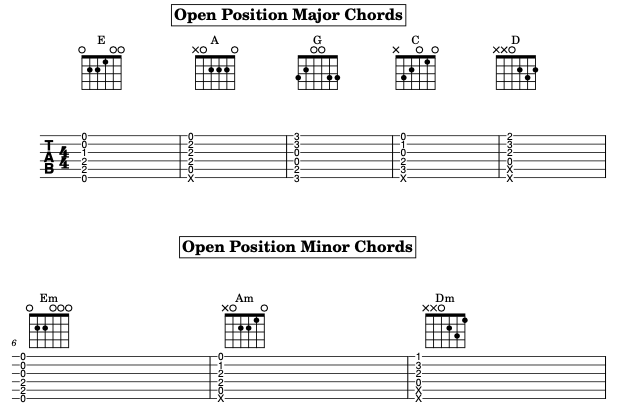
Learning the shapes is only half the work. The other half is transitioning between them smoothly, in time, without hesitation. This is where most beginners struggle, and it’s where focused practice with a metronome makes all the difference.
Critical Technique Details
String muting: When playing C, A, D, Am, or Dm, the low E string must be muted. Let your thumb rest lightly against it from behind the neck. Letting it ring produces a muddy, wrong-sounding chord. This is one of the most common beginner mistakes.
Finger placement: Press the strings with your fingertips, close to the fret wire (but not on top of it). This produces the cleanest sound with the least effort. Flat fingers or placement in the middle of the fret space leads to buzzing and muted strings.
Chord transitions: Practice switching between two chords in a loop with a metronome at a slow tempo. Identify shared fingers (a “pivot point”) between shapes and keep those fingers planted while the others move. Move fingers together as a unit rather than one at a time.
Barre Chords: Unlocking the Entire Fretboard
Barre chords take your open chord shapes and make them movable. Your index finger presses across all strings (acting as a moveable capo), while your remaining fingers form the familiar chord shape behind it. The E, Em, A, and Am barre shapes below allow you to play any major or minor chord anywhere on the neck.
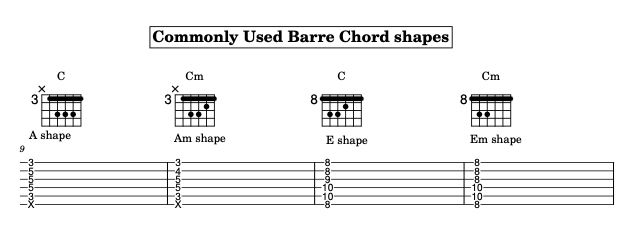
Barre chords are the biggest technical hurdle for most guitarists. Here’s how to overcome the common frustrations:
Pain and fatigue: Don’t squeeze harder. Instead, position your index finger on its bony side (slightly rolled toward the nut), place your thumb in the center of the neck’s back, and bring your elbow toward your rib cage to keep your hand parallel to the frets. Use arm strength to pull back rather than squeezing between thumb and fingers.
Buzzing strings: Ensure your index finger is close to the fret wire, not in the middle of the fret space. Check that your other fingers are curled enough that they aren’t touching adjacent strings. If buzzing persists, your guitar’s action (string height) may be too high. A setup adjustment can help significantly.
Building endurance: Practice barre chords in short bursts (1-2 minutes), rest, then repeat. Muscle strength and endurance build over weeks, not days. Accept that this is a physical development process and be patient with it.
Learning barre chords eliminates the need for a capo in most situations. While capos are useful tools, relying on them exclusively prevents full fretboard development. Our complete barre chord guide provides detailed exercises and troubleshooting.
Power Chords: The Sound of Rock
Power chords strip away the 3rd, leaving just the root and 5th (sometimes doubling each note in different octaves). This gives a tonally ambiguous sound, because it’s neither major nor minor, and is the signature of rock, punk, and metal. Combined with distortion, overdrive, or fuzz, power chords produce the aggressive, driving sound behind “You Really Got Me,” “Highway to Hell,” “Smells Like Teen Spirit,” “Iron Man,” “American Idiot,” and “Master of Puppets.”
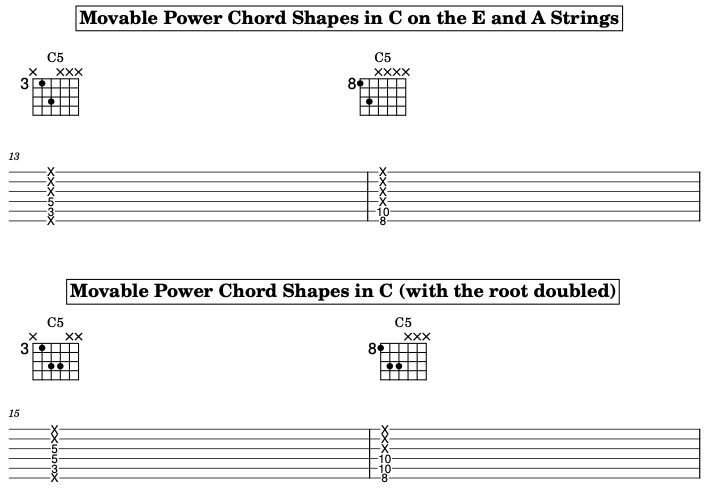
Power chords are ergonomically simple because they often just use two or three fingers on adjacent strings and are completely movable. Learn the shape rooted on the E string and the A string below, and you can play power chords in any key. Pair them with palm muting for the tight, chugging rhythm that defines heavy music.
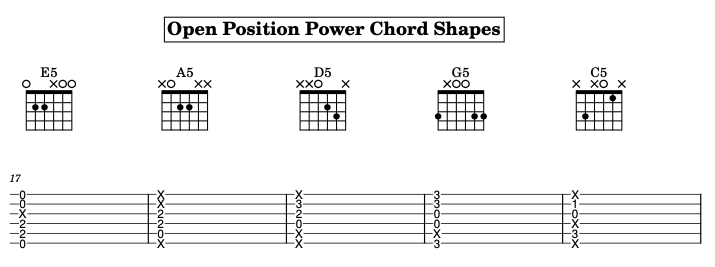
Power chords can also be played in open position. AC/DC’s most iconic songs, such as “Back in Black,” “TNT,” “It’s a Long Way to the Top,” and “You Shook Me All Night Long,” make extensive use of open-position power chords, as shown below.
Triads and Inversions (Intermediate)
Triads are three-note chords, consisting of a root, 3rd, and 5th, played on smaller string sets (three adjacent strings) rather than across all six strings. There are four types: major (1, 3, 5), minor (1, ♭3, 5), augmented (1, 3, #5), and diminished (1, ♭3, ♭5).
What makes triads powerful is inversions. Root position puts the root as the lowest note. First inversion puts the 3rd on the bottom. Second inversion puts the 5th on the bottom. Learning all three inversions across different string sets unlocks voice leading. This is the ability to move between chords with minimal finger movement, creating smooth, flowing progressions rather than jumping between distant shapes. Below are all the different triad types, shapes, and inversions in C on all four string sets:
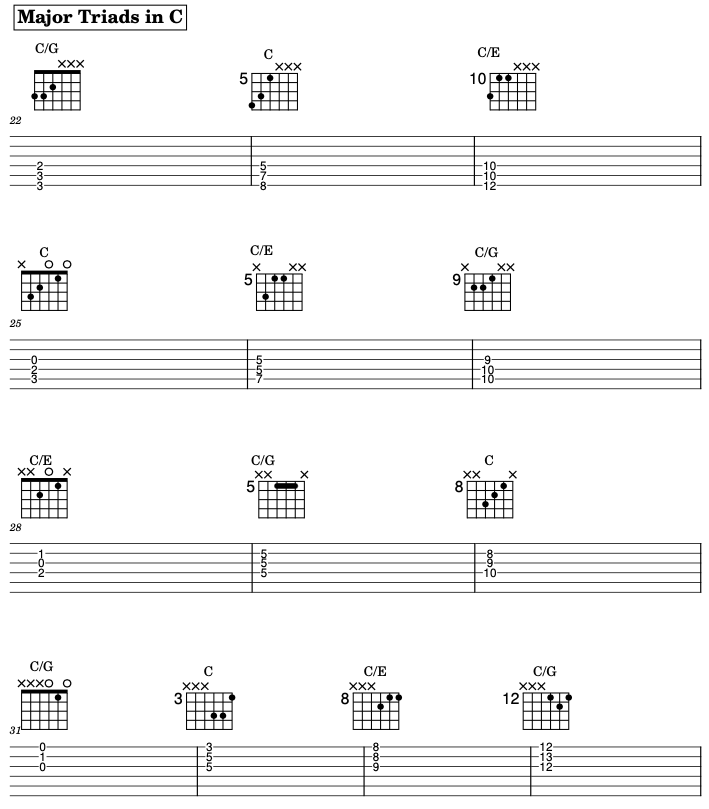
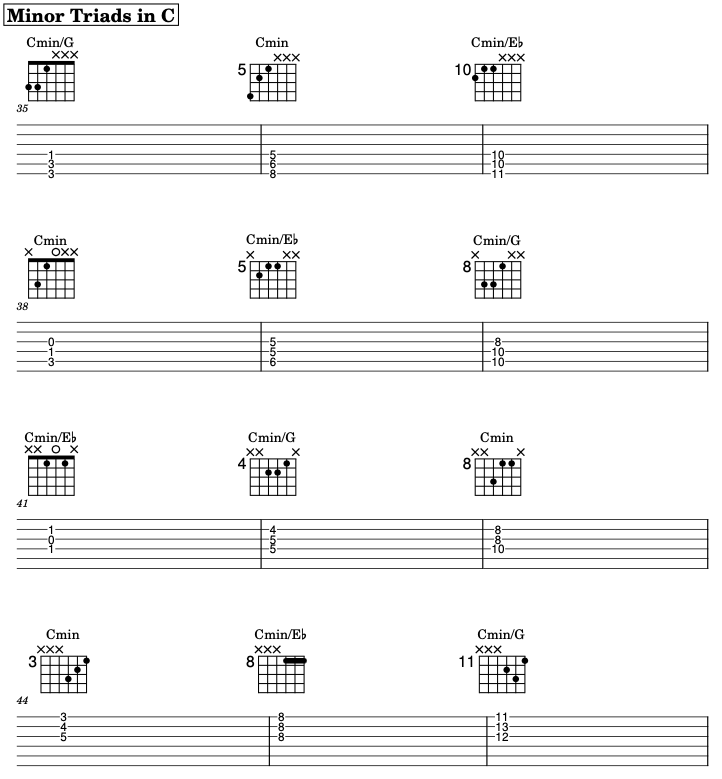
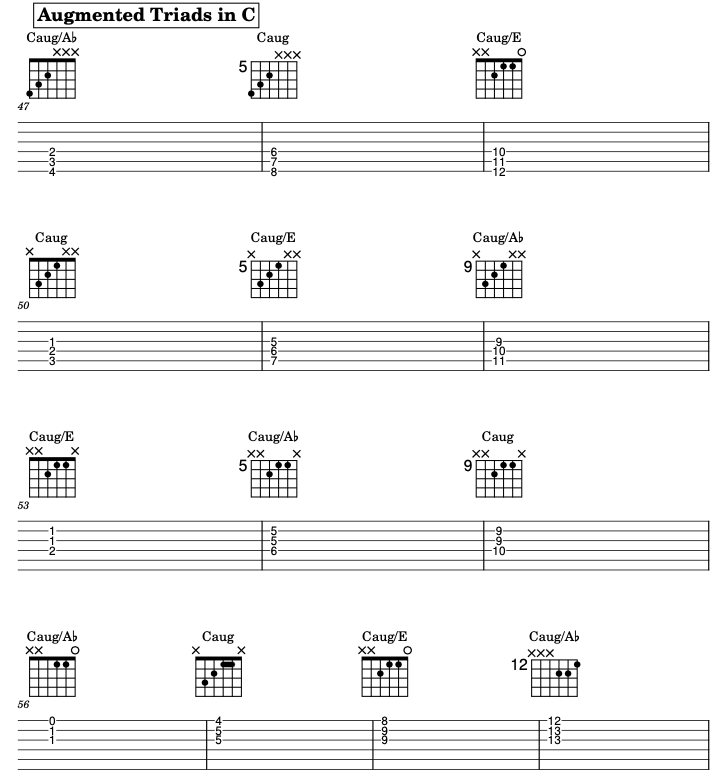
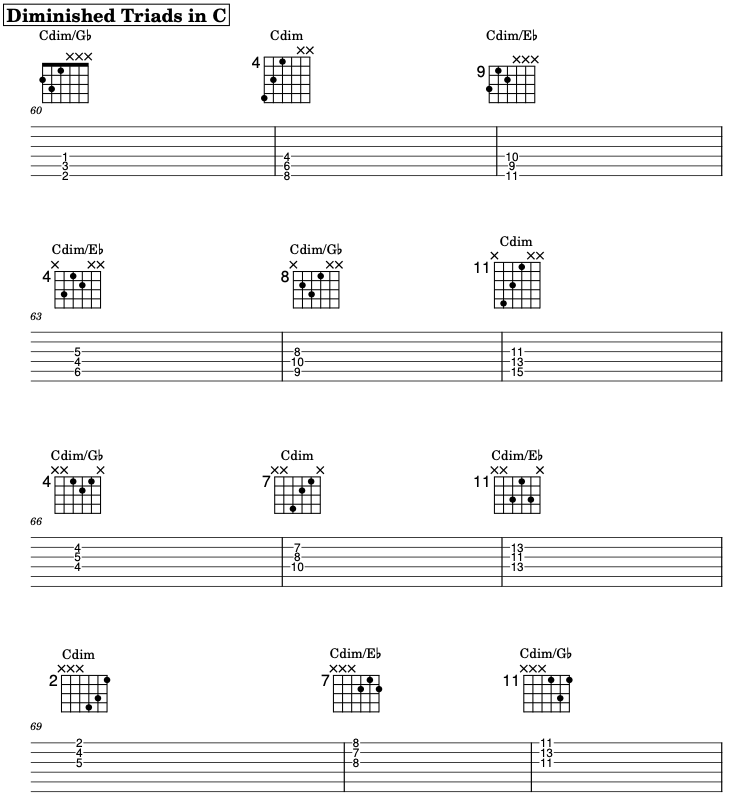
Guitarists like Hendrix, Mayer, and Frusciante use triads to create rhythm parts that sound melodic and sophisticated. Combined with hammer-on and pull-off embellishments, triads transform basic progressions into something that sounds pianistic and layered. Our triads and inversions guide covers all four types across every string set.
Fun fact: Augmented triads are symmetrical! You can use the same shapes for Caug, Eaug, and G#/A♭aug. To put it another way, Caug = Eaug = G#/A♭aug. This also means that you can move the same shape for Eaug on the top three strings up and down major 3rds and still play the same chord, just with different inversions.
Spread Triads (Advanced)
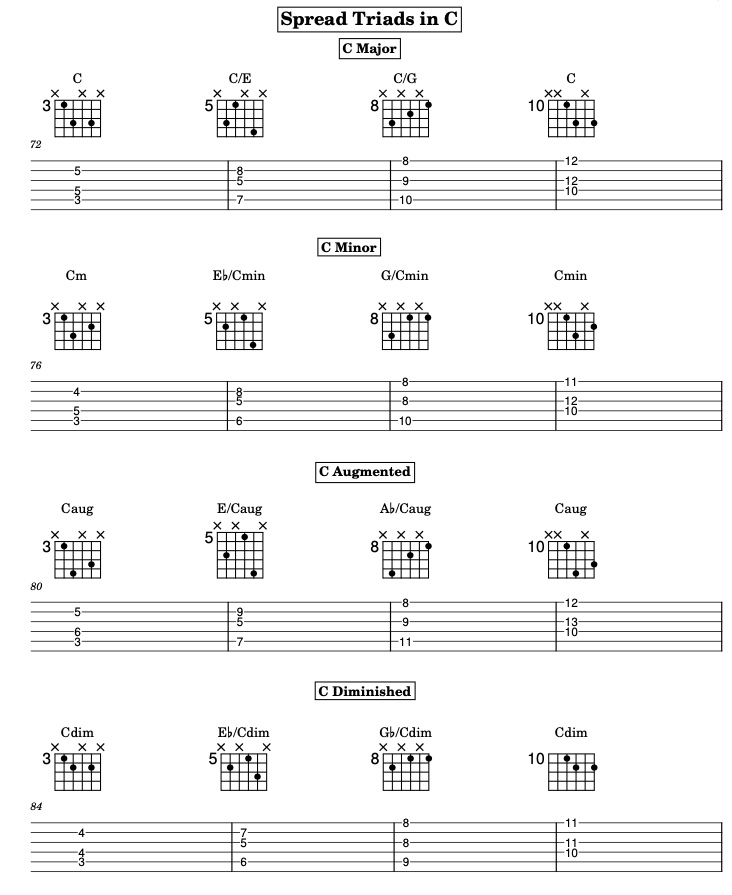
Spread triads take a closed-voice triad and move the middle note up an octave, creating an open, lush, almost classical sound. Eric Johnson is famous for using spread triads extensively. They sound beautiful in fingerpicking contexts and add sophistication to acoustic arrangements. Below is how to play them in C in different inversions:
Sus and Suspended Chords (Intermediate)
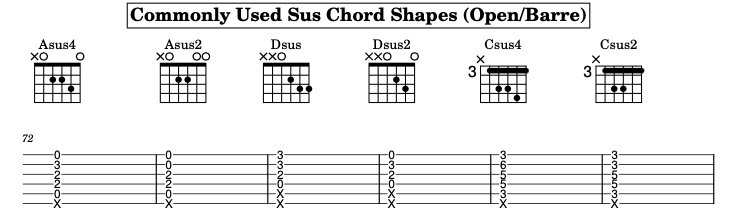
Suspended chords replace the 3rd with either a 2nd (sus2) or 4th (sus4). Without the defining major or minor 3rd, these chords feel unresolved and floating. They create tension that typically resolves to a neighboring major or minor chord. “The Unforgiven” by Metallica, “Crazy Little Thing Called Love” by Queen, and much of The Who’s catalog make heavy use of suspended chords.
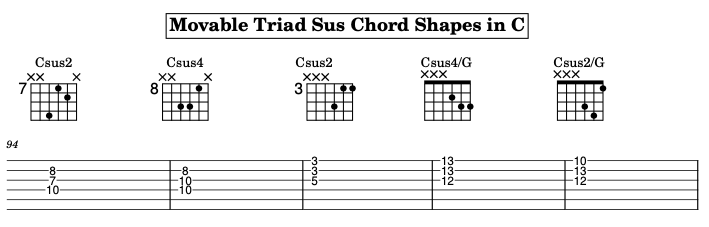
Sus chords are easy to form because they’re typically one finger added or removed from a familiar open or barre chord or triad shape. They’re an excellent way to add movement and interest to simple progressions without learning entirely new voicing systems. Below are some common sus chord shapes.
7th Chords (Intermediate)
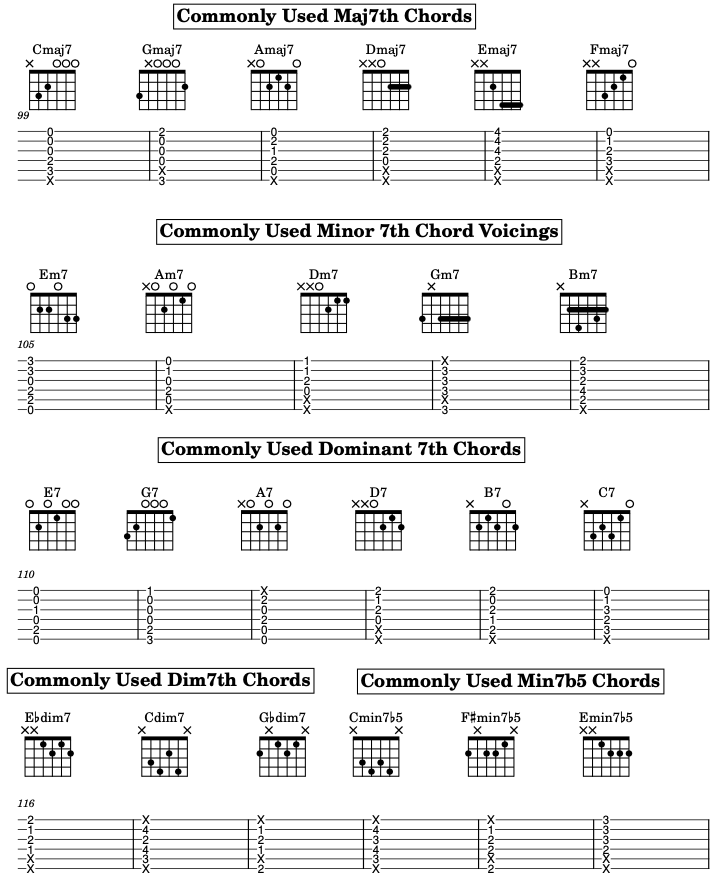
7th chords add a fourth note to the basic triad, creating richer, more colorful harmony. Many of these chord types are common in styles like Jazz, R&B, Soul, and Funk, but are also occasionally used in Pop and Rock. The five most common types are:
Major 7th (1, 3, 5, 7): Dreamy, smooth, sophisticated. In C: C, E, G, B.
Dominant 7th (1, 3, 5, ♭7): Bluesy, gritty, with a pull toward resolution. In C: C, E, G, B♭.
Minor 7th (1, ♭3, 5, ♭7): Mellow, warm, relaxed. In C: C, E♭, G, B♭.
Diminished 7th (1, ♭3, ♭5, ♭♭7): Although tense and dramatic, Dim7th chords are symmetrical, which means that the same shape for any chord can be used a minor third away. For example, C dim7, A dim7, E♭dim7 (aka D#dim7), and G♭dim7 (aka F#dim7) all use the same notes. In C: C, E♭, G♭, B♭♭
Minor 7♭5 / Half-Diminished (1, ♭3, ♭5, ♭7): Dark and sophisticated. Appears frequently in jazz progressions. In C: C, E♭, G♭, B♭
Most 7th chord voicings can be created by modifying familiar barre and open chord shapes. This can be done by adding or removing a single finger. This makes them more approachable than they look on paper. Below are some common 7th chord voicings on guitar:
Advanced Voicings: Shell, Drop 2/3, Extensions
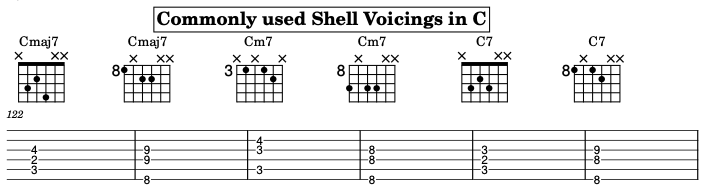
Shell voicings strip 7th chords down to their three most essential notes: root, 3rd, and 7th. The 5th is eliminated because it adds the least harmonic color. Shell voicings are compact, easy to play quickly, and lay naturally on the fretboard. They’re the backbone of jazz comping and big band guitar. Below are some common Shell voicings in C:
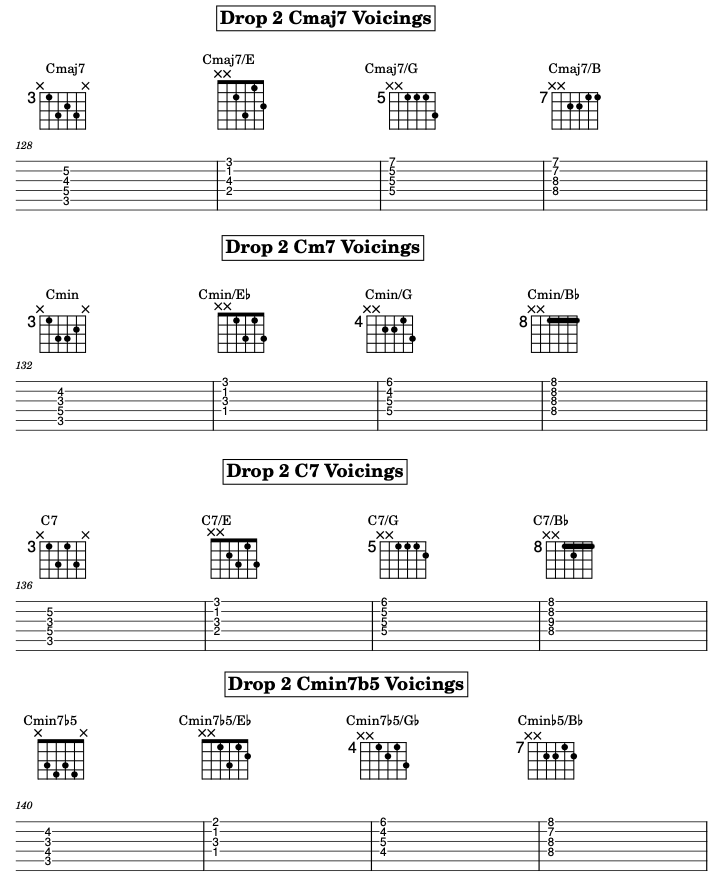
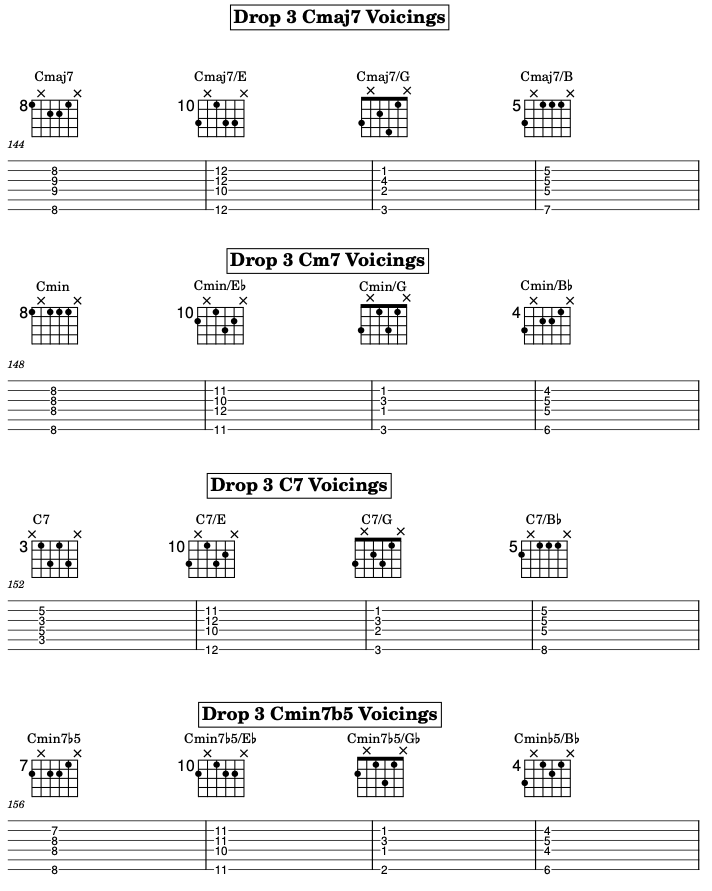
Drop 2 and Drop 3 voicings rearrange chord tones by dropping the 2nd or 3rd highest note down an octave. This creates more open, resonant voicings that are ergonomically practical on guitar, where closed-position 7th chords (that are easy to play on piano) are often awkward to finger. Below is how to play some common Drop 2 and 3 voicings in all four inversions:
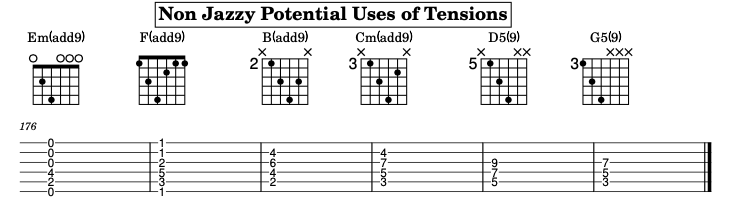
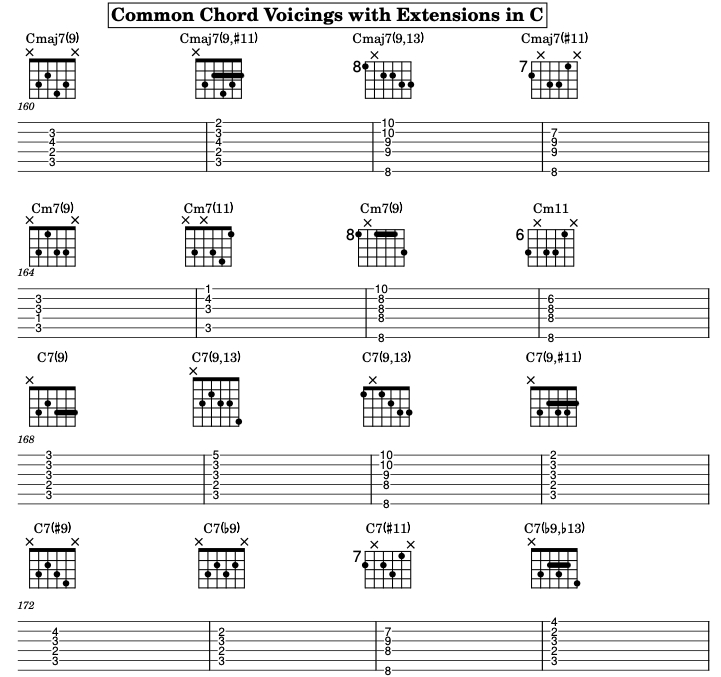
Chord extensions add 9ths, 11ths, and 13ths on top of 7th chords, creating lush, rich harmony. These are standard in jazz but also appear in rock and pop. Songs like “Breathe in the Air” by Pink Floyd, “Message in a Bottle,” and “Every Breath You Take” by The Police all feature extended chord voicings that give them their distinctive color. Below are some common non-jazzy ways extensions can be used for barre chords, open chords, and power chords:
Below are some commonly used jazzy 7th chord voicings with extensions:
Building Your Chord Vocabulary Efficiently
You don’t need to learn every chord type before you start playing music. Here’s how to build your vocabulary strategically:
Start playing songs immediately. Learn the chords a specific song requires, then learn the next song. Each song teaches you a few new shapes in a musical context, which is far more motivating and effective than memorizing chord charts in isolation.
Learn chord families, not individual chords. When you learn a G major open chord, also learn G minor, G7, and Gmaj7. This builds understanding of how chord types relate to each other, not just how to form isolated shapes.
Connect shapes across the fretboard. Once you know open G and the G barre chord, learn the G triad in three inversions. Now you can play G anywhere on the neck in multiple voicings. This kind of fretboard fluency is what separates intermediate players from beginners.
If you’re ready to build a guitar chord vocabulary with expert guidance, our guitar lessons at Musicians Playground are designed for adult learners at every level. Our instructors build your chord knowledge through the songs you love, ensuring that every new shape has a musical context. Visit our complete guide to guitar lessons in Boston to learn more.
Frequently Asked Questions
How many guitar chords do I need to know?
You can play thousands of songs with just 8-10 chords (the basic open major and minor shapes plus a few barre chords). However, expanding into 7th chords, triads, and suspended chords dramatically increases your versatility and the sophistication of your playing.
Why do my barre chords buzz?
The most common cause is index finger placement too far from the fret wire. Move your finger closer to the fret, roll it slightly onto its bony side, and ensure your other fingers aren’t accidentally touching adjacent strings. A guitar setup with lower action also makes barre chords significantly easier.
Do I need to learn music theory to understand chords?
Not initially. You can learn chord shapes by pattern and play them effectively without understanding the theory behind them. However, basic theory, such as understanding intervals, how chords are built from scales, and how keys work, makes learning new chords faster and helps you understand why certain chords sound good together.
What’s the fastest way to learn new chord shapes?
Learn them in the context of songs you want to play. When a song requires a chord you don’t know, learn that specific shape and practice it within the song’s progression. This gives you immediate musical context and motivation, which produces faster retention than memorizing shapes in isolation.