
Guitar Triads and Chord Inversions Guide
Updated April 7, 2026
If open chords and barre chords are the guitar’s foundation, guitar triads are what make it musical. Triads let you play chords in multiple voicings across the entire fretboard, connect progressions with smooth voice leading, and create rhythm parts that sound melodic, sophisticated, and professional rather than just strumming the same shapes over and over.
This guide covers all four triad types, all three inversions, and how to apply them musically, including the Hendrix-style embellishments that transformed rhythm guitar forever. For the complete rhythm guitar curriculum, see our Ultimate Guide to Rhythm Guitar.
What Is a Triad?
A triad is a three-note chord built by stacking two intervals of a third. Unlike full barre chords or open chords that use 4-6 strings, triads are played on just three adjacent strings. This compact format makes them nimble, easy to move around the fretboard, and perfect for creating parts with melodic movement.
There are four triad types, each with a distinct sound:
Major (1, 3, 5): Bright and stable. The standard “happy” chord sound. Built from a major 3rd plus a minor 3rd.
Minor (1, ♭3, 5): Darker and more melancholic. Built from a minor 3rd plus a major 3rd.
Augmented (1, 3, #5): Tense and unstable, with a dreamy, mysterious quality. Built from two major 3rds. Used sparingly for creating tension.
Diminished (1, ♭3, ♭5): Dark and dissonant. Built from two minor 3rds. Creates strong tension that demands resolution.
Major and minor triads are by far the most commonly used. Augmented and diminished triads appear less frequently but are valuable for creating tension and color in your progressions.
Inversions: The Key to Fretboard Freedom
Every triad can be played in three positions, called inversions, depending on which note is on the bottom:
Root position: The root is the lowest note (e.g., C-E-G for C major). This is the most stable and grounded sound.
First inversion: The 3rd is the lowest note (e.g., E-G-C for C major). This creates a slightly lighter, more open sound.
Second inversion: The 5th is the lowest note (e.g., G-C-E for C major). This sounds more suspended and less resolved than root position.
Here’s why inversions matter: without them, changing from C major to F major might require jumping your hand several frets up the neck. With inversions, you can find a C voicing and an F voicing that are right next to each other, sometimes just one fret apart. This is called voice leading, and it’s what makes professional rhythm guitar sound smooth and connected rather than choppy.
Learning Triads Across String Sets
Practice triads on all four string groups: strings 6-5-4, strings 5-4-3, strings 4-3-2, and strings 3-2-1. Each string set produces a slightly different tonal character. Lower string sets sound warmer and fuller, while higher sets sound brighter and more cutting.
For each string set, start by learning all three inversions of major and minor triads. Start in one key (C major/A minor is standard), then transpose to all 12 keys by shifting the shapes up and down the neck. Because the patterns are movable, learning them in one key teaches you every key simultaneously. Learn augmented and diminished triads for each string set and inversion later.
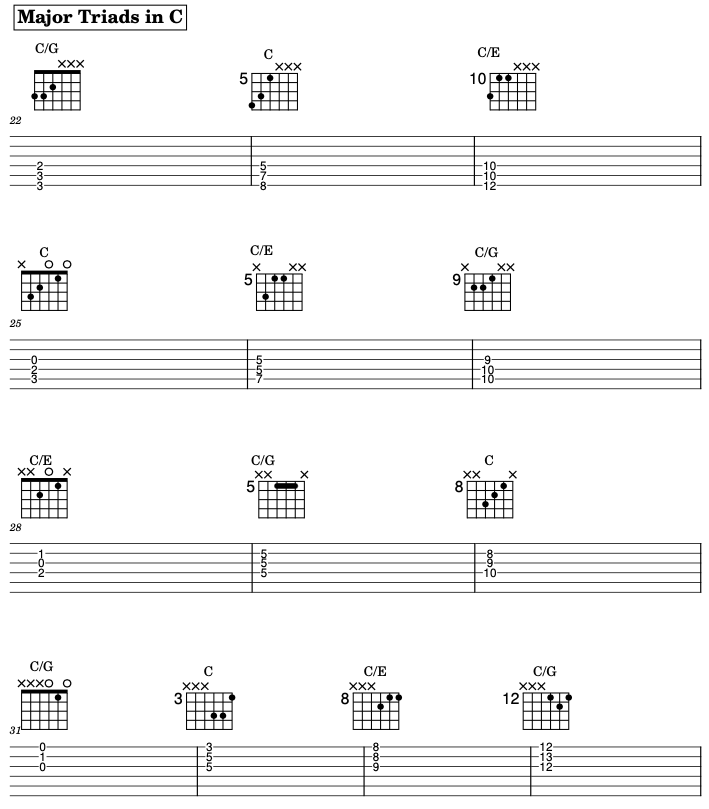
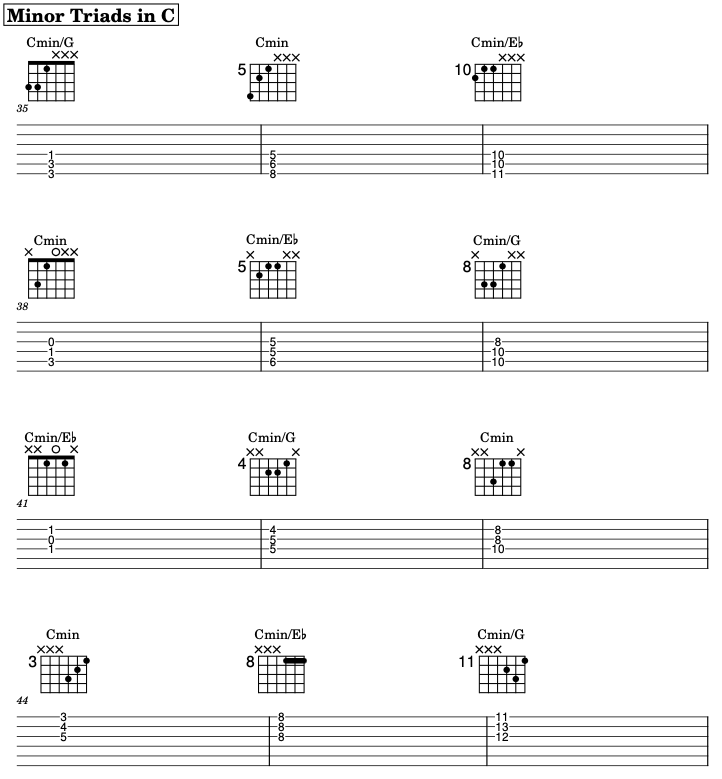
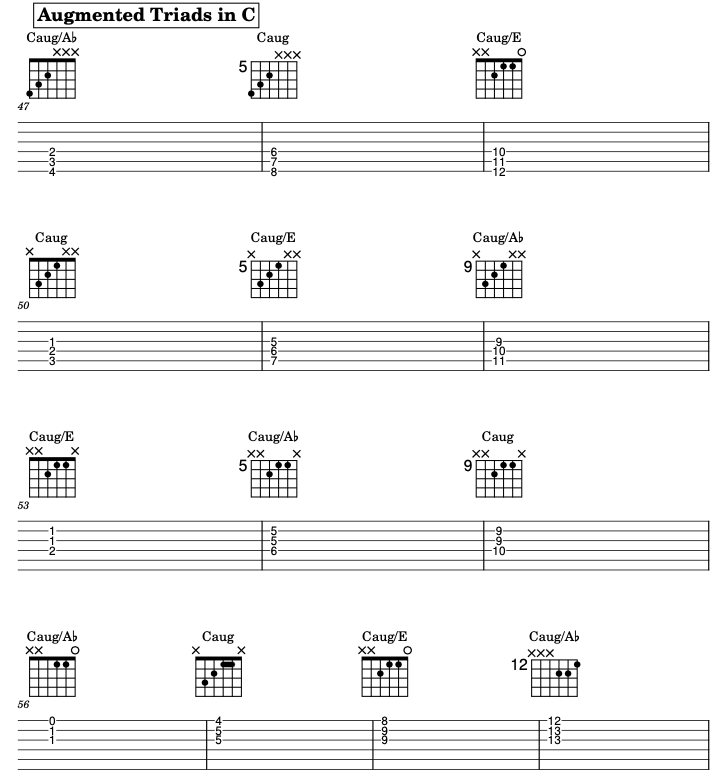
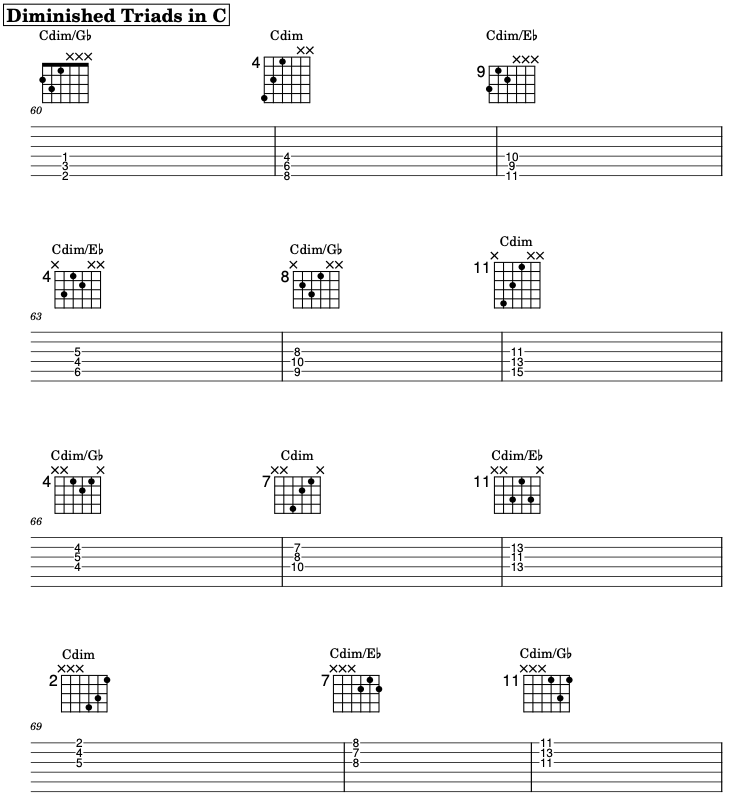
The upper string sets (4-3-2 and 3-2-1) are particularly important because they’re the foundation of the Hendrix-style embellishments discussed later in this guide.
Voice Leading in Practice
Voice leading means connecting chords so that each individual note moves as little as possible to the next chord. Instead of jumping between distant chord shapes, you find nearby voicings where the notes shift by just a fret or two or stay on the same note entirely (called a common tone).
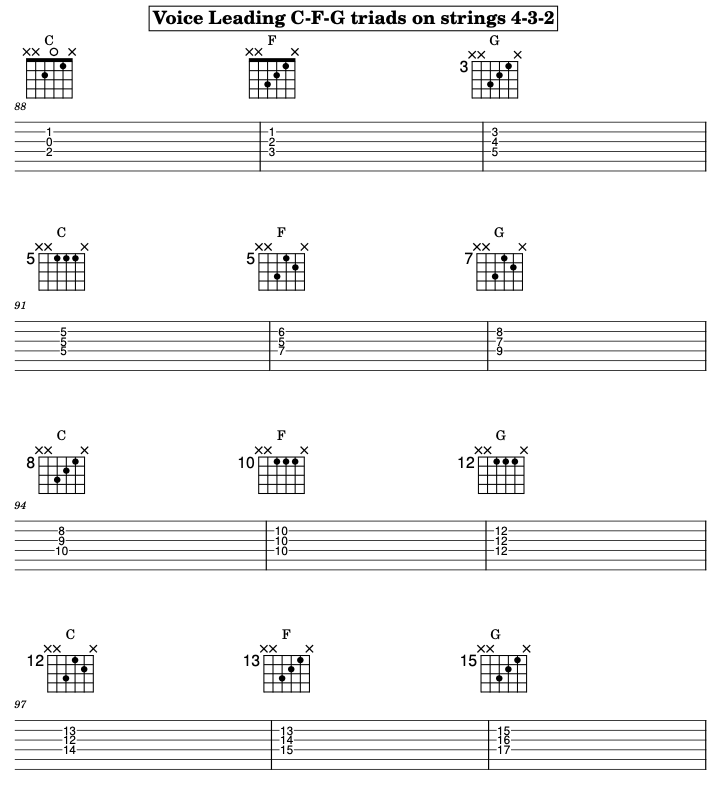
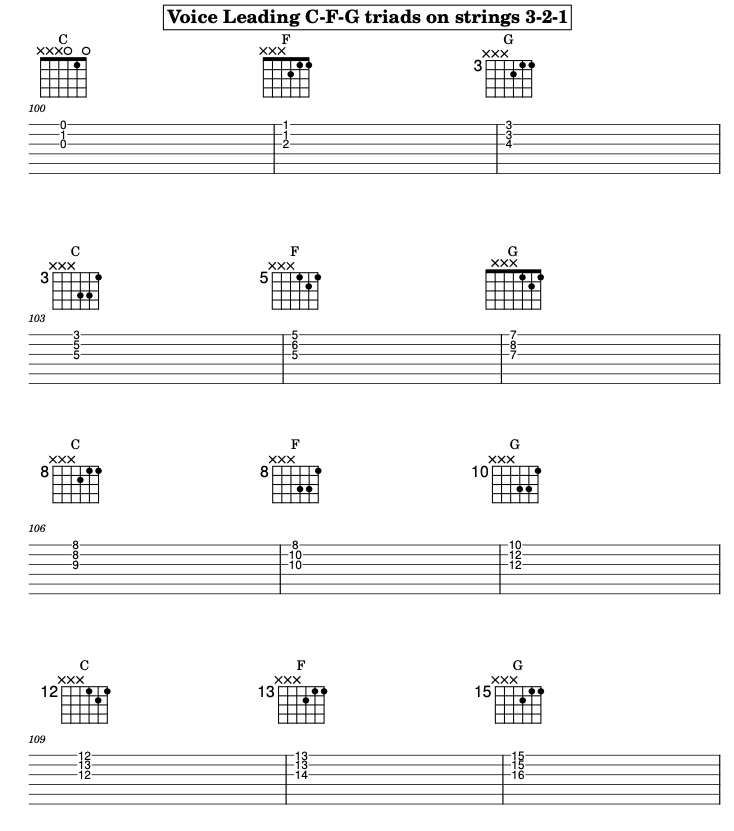
For example, playing a C-F-G progression using triads on the top three strings: you might use a root position C triad, move to an F triad at the 5th fret (just shifting two fingers up), then to a G triad a whole step up. The movement is minimal, the sound is smooth, and it’s much more musical than jumping between open C, F barre, and open G chords.
Voice leading is what gives professional guitar parts their polished quality. It’s the technique behind the rhythm playing of Hendrix, Mayer, Frusciante, and nearly every session guitarist working today. Below are some common ways you can voice lead triads with the C-F-G progression on strings 4-3-2 and 3-2-1:
Hendrix-Style Triad Embellishments
Jimi Hendrix revolutionised rhythm guitar by combining upper-string triads with hammer-ons, pull-offs, and pentatonic fills. The result is a pianistic style that blurs the line between rhythm and lead. Chord shapes come alive with more melodic movement and dynamic variation.
The basic concept: hold a triad shape on the D-G-B or G-B-E strings and use your available free finger(s) to hammer onto or pull off from notes within the chord or the surrounding pentatonic scale. You can also wrap your thumb around the neck to fret bass notes on the low E string while your fingers play triads on the higher strings.
Songs to study: “Little Wing,” “Castles Made of Sand,” and “All Along the Watchtower” by Hendrix. “Slow Dancing in a Burning Room” and “Gravity” by John Mayer. “Under the Bridge” by Red Hot Chili Peppers. “Yellow Ledbetter” by Pearl Jam. Each demonstrates how triads with embellishments create rhythm parts that sound like multiple instruments playing simultaneously.
One common mistake is using full barre chords instead of triads for this style. The point is compact, upper-register voicings that leave fingers free for embellishment. Full barre chords lock all your fingers in place, eliminating the freedom that makes this technique work.
Spread Triads (Advanced)
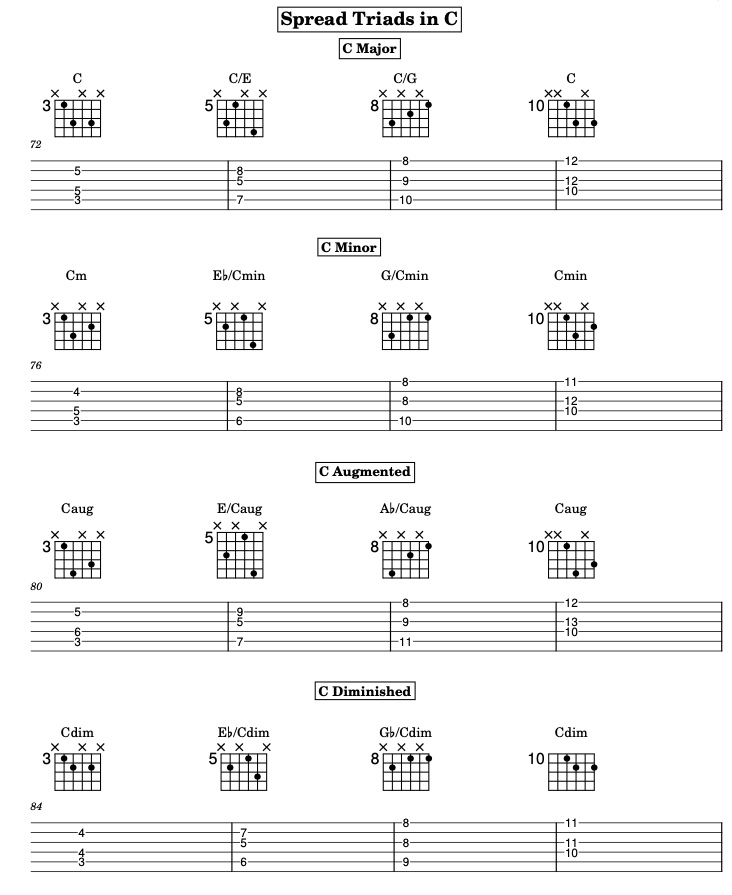
Spread triads (also called open-voice triads) take a standard closed-voice triad and move the middle note up an octave. This creates a wider, more resonant voicing with a more classical and pianistic quality.
For example, a C major root position triad in closed voicing is C-E-G. As a spread triad, the E moves up an octave: C-G-E. The sound is more open and lush compared to the compact sound of a closed triad.
Eric Johnson is famous for his extensive use of spread triads. Bach’s Cello Suite No. 1 in G major showcases spread triads throughout.
Practical Practice Plan for Triads
Month 1: Learn major and minor triads in all three inversions on the top string set (3-2-1). Practice moving through a simple progression (C-Am-F-G) using the closest available inversion for each chord change. Focus on smooth voice leading.
Month 2: Expand to the 4-3-2 string set and begin learning triads on the 5-4-3 set. Start combining triads with simple hammer-on embellishments, and add one note at a time.
Month 3: Practice Hendrix-style embellishments over familiar chord progressions. Learn “Little Wing” or “Slow Dancing in a Burning Room” as a study piece. Begin exploring spread triads.
Month 4+: Apply triad voicings and embellishments to songs you’re playing in lessons or with your band. Start connecting triads with pentatonic fills for seamless rhythm-lead integration.
If you’re ready to develop your guitar triad fluency with expert guidance, our guitar instructors at Musicians Playground teach triads through the songs and styles you love. Voice leading and triad embellishments are among the skills that benefit most from one-on-one instruction, because small hand position adjustments make a huge difference in fluency. Our BAND+ program is the perfect place to apply these skills in a band context. Visit our complete guide to guitar lessons in Boston to learn more.

Frequently Asked Questions
Are triads just for advanced players?
Not at all. Basic major and minor triads on the top three strings are accessible to any intermediate player who knows their open and barre chords. The concept is simple: three notes on three strings. The depth comes from learning inversions and applying them musically, which develops gradually.
Do I need to learn triads if I already know barre chords?
Yes. Barre chords and triads serve different purposes. Barre chords provide full, rich voicings for standard rhythm playing. Triads give you compact shapes for voice leading, melodic embellishment, and blending rhythm with lead playing. Professional guitarists use both constantly.
How do triads help with songwriting?
Triads make chord progressions more interesting by offering multiple voicings for the same chord. Instead of playing the same G barre chord every time, you can choose different triad inversions and string sets that create different textures and moods. Voice leading between triads also suggests melodic ideas that can inspire new songs. If you’re interested in developing your songwriting skills, triad knowledge is invaluable.
What’s the difference between triads and arpeggios?
A triad is the chord itself, three notes played simultaneously or as a shape. An arpeggio is the technique of playing a chord’s notes one at a time in sequence. You can arpeggiate a triad by picking its three notes individually rather than strumming them together. Both concepts use the same notes but apply them differently.