Guitar Scales for Soloing: A Practical Guide
Updated August 8, 2026
Learning scales is one of those things every guitarist knows they should do but few approach strategically. You might have memorized a pentatonic box shape and wondered, “Now what?” Or maybe you’ve heard that modes are important but can’t figure out how to actually use them in a solo. This guide cuts through the confusion and gives you a practical roadmap for learning the most important guitar scales for soloing in the right order, with the right priorities.
This post draws from the scale curriculum our working Boston musicians use with adult students at Musicians Playground in Boston. For the complete picture including advanced techniques and solo recommendations, see our Ultimate Guide to Lead Guitar.

The Order That Actually Matters
Not all guitar scales for soloing are created equal. Some will be useful in 90% of the music you play. Others are specialized tools you’ll reach for occasionally. Here’s the learning order that gets you soloing musically as quickly as possible:
Priority 1: Minor Pentatonic and Blues Scales. Your bread and butter for rock, blues, pop, and funk soloing.
Priority 2: Major Pentatonic Scale, essential for country, classic rock, and brighter-sounding solos.
Priority 3: Major and Natural Minor Scales, the foundational scales of Western music that expand your note choices dramatically.
Priority 4: Harmonic and Melodic Minor Scales, for more advanced and distinctive sounds.
Priority 5: Modes, for sophisticated improvisers who want specific tonal colors.
Most guitarists spend the majority of their time with Priorities 1 and 2. That’s not a limitation; it’s a reflection of how much music these scales cover. Let’s dig into each one.
Minor Pentatonic Scale: Your Foundation
The minor pentatonic is the first scale every aspiring lead guitarist should learn. Its five notes (1, ♭3, 4, 5, ♭7) are practically guaranteed to sound good over any blues, rock, or minor key progression. There’s a reason this scale appears in solos from B.B. King to Slash to Jack White.
In the key of A minor, those notes are A, C, D, E, and G. The first position (rooted at the 5th fret) is the most commonly used shape and should be your starting point.
How to actually use it: Don’t just run the scale up and down. Instead, try playing just 3-4 notes from the scale over a backing track. Repeat a small phrase, then vary it slightly. Leave gaps. This approach develops phrasing from day one, which is far more musical than playing all five notes in order. If you’re new to lead playing, our beginner’s guide to lead guitar walks through this process step by step.
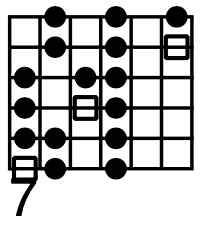
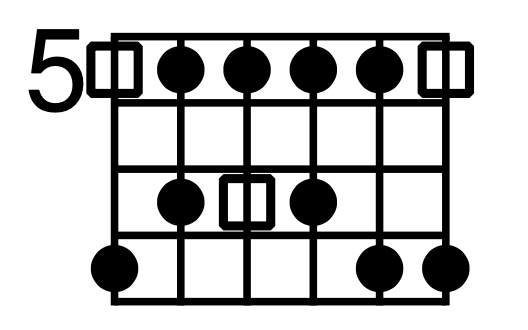
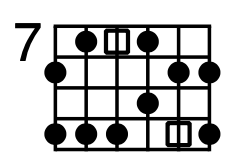
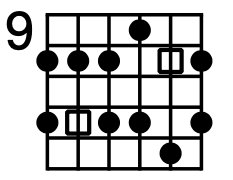
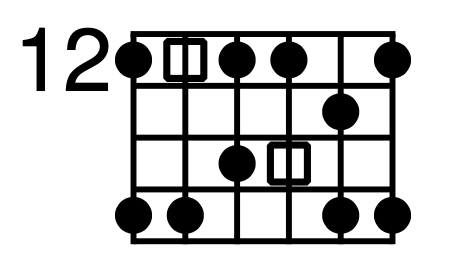
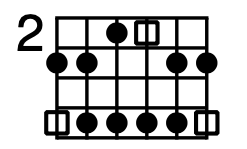
The goal: Learn all five positions of the minor pentatonic scale across the fretboard as seen below in A minor. This takes time, but it gives you complete freedom to solo anywhere on the neck. Work through one position at a time and master each before moving to the next. Practice connecting adjacent positions so you can move fluidly between them.






Blues Scale: One Note Changes Everything
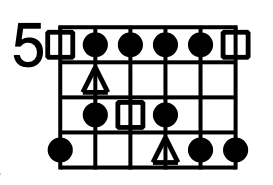
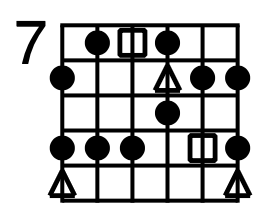
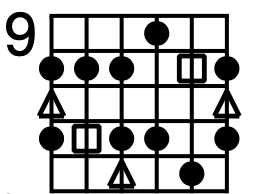
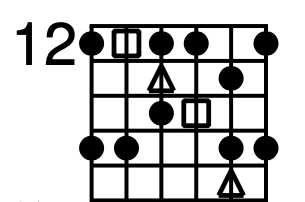
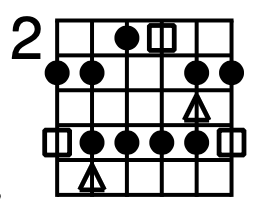
The blues scale is the minor pentatonic with one added note: the ♭5, often called the “blue note” (as seen below, it’s color-coded in blue). Its scale degrees are 1, ♭3, 4, ♭5, 5, ♭7. That single addition creates a tension-and-release quality that defines the blues sound.
In A minor, the blues scale gives you A, C, D, E♭, E, and G. The ♭5 (E♭) is a passing tone. In certain contexts, you don’t usually rest on it, but sliding/bending into or out of it creates that unmistakable bluesy character.
How to actually use it: Think of the ♭5 as a spice, not a main ingredient. Use it to add flavor between the 4th and 5th scale degrees. Try bending or sliding from the ♭5 up to the 5th or down to the 4th. It’s one of the most expressive sounds on the guitar. Practice the blues scale in all 12 keys and all five positions to develop full fretboard fluency. Below is the Blues Scale in all 5 positions in A minor.





Major Pentatonic Scale: The Brighter Side
Where the minor pentatonic sounds dark and bluesy, the major pentatonic sounds bright, happy, and uplifting. Its notes are 1, 2, 3, 5, and 6. In A major, that’s A, B, C#, E, and F#.
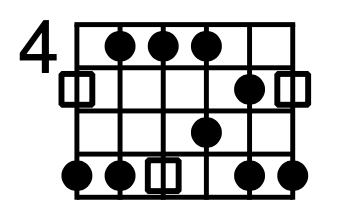
Here’s a useful shortcut: the major pentatonic scale uses the exact same shape as the minor pentatonic, just starting from a different root. As you can see on the right, the A major pentatonic shape is identical to the 2nd position F# minor pentatonic shape. Once you know all your minor pentatonic positions, you already know all your major pentatonic positions.
How to actually use it: The major pentatonic is your go-to for soloing over major key progressions. It works beautifully over country, classic rock (think “Sweet Home Alabama”), and upbeat pop. Many guitarists mix minor and major pentatonic over the same progression for a blues-rock hybrid sound. Switching between the two creates tonal variety that keeps your solos interesting.

Major and Natural Minor Scales: The Full Picture
The pentatonic scales are subsets of these larger seven-note scales. Learning the complete major and natural minor scales gives you two additional notes to work with, expanding your melodic possibilities significantly.
The Major Scale
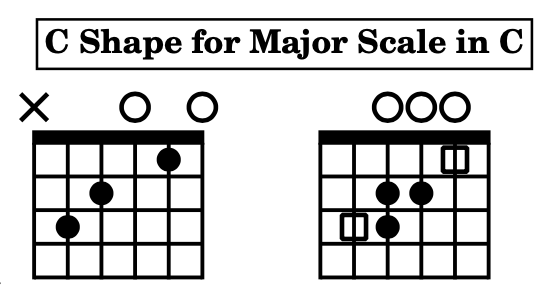
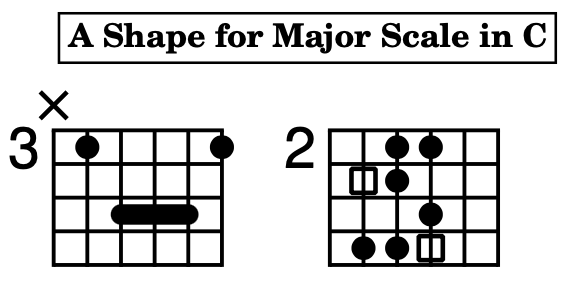
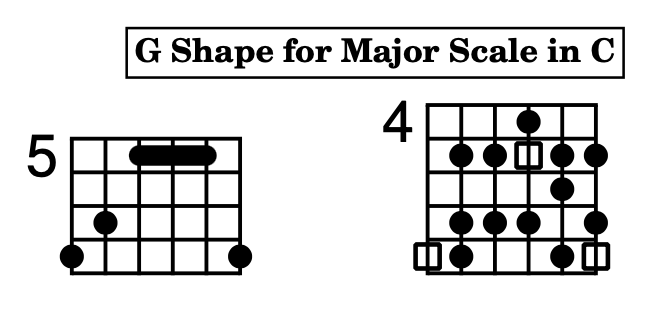
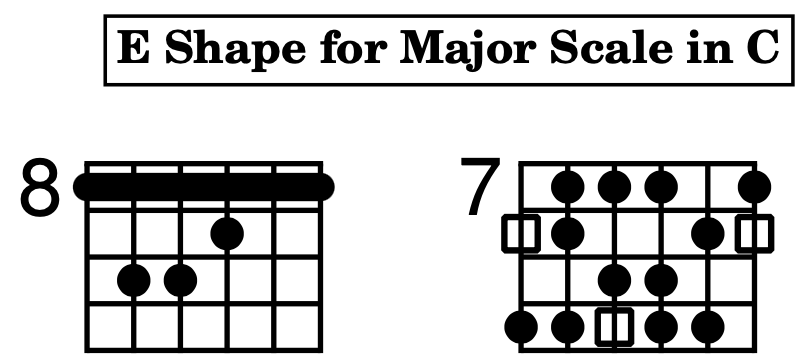
The major scale (1, 2, 3, 4, 5, 6, 7) is the foundational scale of Western music. In C major, those notes are C, D, E, F, G, A, and B, and are all the white keys on a piano. If you play piano as well, you’ve likely encountered this scale already.
For guitarists, learning the major scale through the CAGED system is particularly effective. The CAGED system uses the five open chord shapes (C, A, G, E, D) as frameworks for playing the major scale in different positions across the fretboard. This approach connects scales to chords in a way that deepens your understanding of both. Below is how to play the C major scale using the CAGED system:




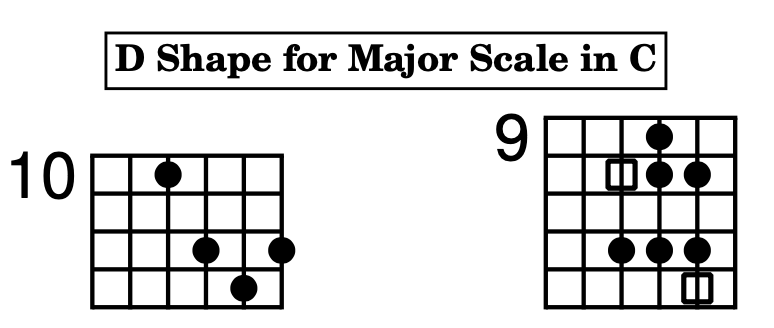

How to actually use it: The major scale works over any major key progression and gives you more note choices than the major pentatonic. The additional notes (the 4th and 7th) add color and movement. Use the pentatonic as your “safe” foundation and incorporate the extra major scale notes to add more color to your melodies and solos.
The Natural Minor Scale
The natural minor scale (1, 2, ♭3, 4, 5, ♭6, ♭7) has a darker, more melancholic quality. In A minor, those notes are A, B, C, D, E, F, and G, which are the same notes as C major, just starting from A. This relationship between relative major and minor keys is fundamental to understanding how scales connect. Below is how to play the A minor scale (notice how it’s based on the E minor barre chord shape on the left):
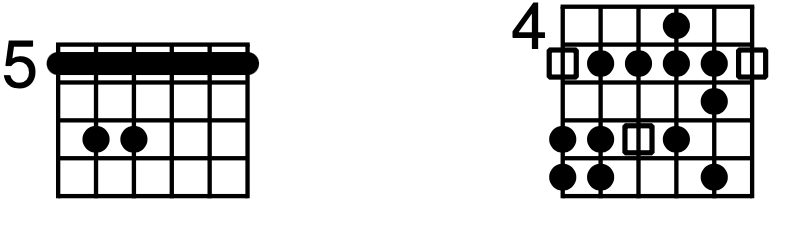

How to actually use it: Like the major scale, the natural minor gives you two additional notes beyond the pentatonic (the 2nd and ♭6th). These extra notes are particularly useful for creating more melodic, singable solo lines. Practice the natural minor in multiple positions and keys, and experiment with mixing pentatonic and full minor scale ideas within the same solo.
Harmonic and Melodic Minor: Expanding Your Sound
These two scales modify the natural minor to create distinctive sounds. They’re not essential for beginners, but intermediate players who want to expand their tonal vocabulary should study both.
Harmonic Minor
The harmonic minor scale raises the 7th degree of the natural minor, giving it a formula of 1, 2, ♭3, 4, 5, ♭6, 7. That raised 7th creates a leading tone that pulls strongly toward the root, producing a darker, more exotic sound. The interval between the ♭6 and natural 7 (an augmented 2nd) is what gives the harmonic minor its distinctively dramatic and almost “Middle Eastern” character. Below is how to play C harmonic minor:
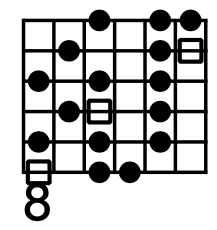

Guitarists like Yngwie Malmsteen built their entire signature sound around extensive use of the harmonic minor. It’s especially effective in metal and neoclassical rock, but also appears in pop music and flamenco. Songs like “Smooth” by Santana, “Bad Guy” by Billie Eilish, and Havana by Camilla Cabello are great examples of this scale in practice.
Melodic Minor
The melodic minor raises both the 6th and 7th degrees (1, 2, ♭3, 4, 5, 6, 7), smoothing out the augmented 2nd interval of the harmonic minor. In classical music, the raised notes only apply when ascending through the scale. When descending the melodic minor scale, this reverts to natural minor. In jazz, the raised notes typically apply in both directions. Below is how to play the C melodic minor scale:
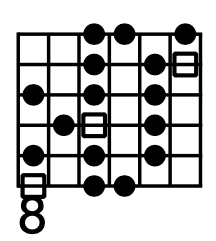

For rock guitarists, the melodic minor scale is less commonly used than the harmonic minor, but it’s worth studying because it produces more fluid, melodic lines and opens the door to understanding jazz-influenced playing.
Modes: Advanced Tonal Colors
Modes are the seven scales that can be built from each degree of the major scale. They’re powerful tools for advanced improvisers, but they often intimidate intermediate players because they seem complicated. The good news: if you know the major scale, you already know all seven modes.
You already know two modes: the Ionian mode (same as the major scale) and the Aeolian mode (same as the natural minor scale). The five remaining modes each have a unique character:
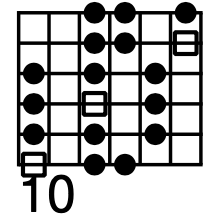
Dorian (1, 2, ♭3, 4, 5, 6, ♭7): A minor mode with a brighter, groovier feel thanks to its natural 6th. You can hear it in songs like “Oye Como Va” by Santana and “Uptown Funk” by Bruno Mars. It’s arguably the most useful mode for rock and pop improvisation after the major and minor scales. Below is how to play the D Dorian mode:

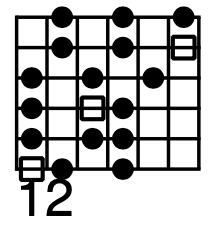
Phrygian (1, ♭2, ♭3, 4, 5, ♭6, ♭7): A darker, more aggressive minor mode. The ♭2 gives it a sinister quality that works perfectly in metal. Metallica and Megadeth use it frequently. Below is how to play E Phrygian:

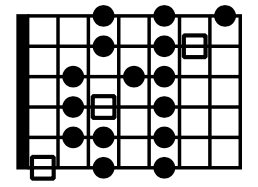
Lydian (1, 2, 3, #4, 5, 6, 7): A major mode with a dreamy, ethereal quality created by the #4. Joe Satriani and Steve Vai use it extensively. It’s the brightest-sounding mode. Below is how to play F Lydian:

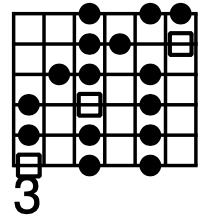
Mixolydian (1, 2, 3, 4, 5, 6, ♭7): A major mode with a bluesy edge from the ♭7. It’s the sound of classic rock. Songs like “Sweet Child O’ Mine” and “Sweet Home Alabama” both feature Mixolydian prominently. Below is how to play G Mixolydian:

Locrian (1, ♭2, ♭3, 4, ♭5, ♭6, ♭7): The darkest and most unstable mode due to its ♭5. It’s rarely used as a standalone scale but appears in metal for creating tension, intensity, and evil sounds. Below is how to play B Locrian