Power Chords and Rock Rhythm Guitar
Updated August 8, 2026
There’s a reason power chords are the first thing most rock guitarists learn: they’re simple, they’re versatile, and plugged into a cranked amp with some distortion, they sound absolutely massive. From AC/DC to Green Day to Metallica, power chords are the harmonic engine behind the most iconic riffs and rhythm parts in rock history.
This guide covers everything you need to know about power chords, from the basic shapes to combining them with palm muting and riff construction for authentic rock rhythm guitar. For the full rhythm guitar curriculum, see our Ultimate Guide to Rhythm Guitar.
What Makes a Power Chord
A power chord takes a standard major or minor triad and removes the 3rd (the note that determines whether a chord sounds major (happy) or minor (sad)). What’s left is just the root and the 5th, often with the root doubled an octave higher. This stripped-down construction is what gives power chords their tonally ambiguous sound.
Because there’s no major or minor 3rd, power chords work over both major and minor progressions. This ambiguity is actually a strength because it lets the melody, vocals, or other instruments define the harmonic character while the guitar provides pure power. That’s why they’re written with a “5” suffix: E5, G5, A5.
The Essential Power Chord Shapes
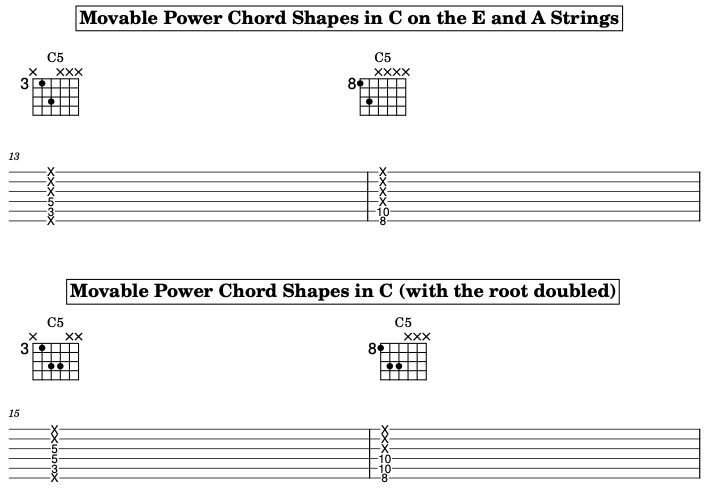
6th string root shape: Place your index finger on any fret of the low E string. That’s your root note. Your ring finger goes two frets higher on the A string, and sometimes your pinky goes on the same fret as the ring finger on the D string (this doubles the root). For example, an index finger on the 8th fret of the E string gives you a C5 power chord.
5th string root shape: Same concept, shifted up one string set. Your index finger goes on the A string, ring finger goes two frets higher on the D string, and sometimes your pinky goes on the G string at the same fret as the ring finger. Index on the 3rd fret of the A string gives you C5.
These two shapes, combined with knowledge of the note names on the E and A strings, let you play power chords in any key anywhere on the neck. It’s the most efficient chord system on the guitar.
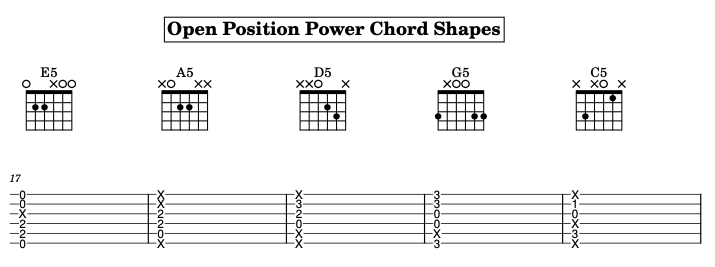
Open Position shapes: Power chords can also be played in open position. AC/DC’s most iconic songs, such as “Back in Black,” “TNT,” “It’s a Long Way to the Top,” and “You Shook Me All Night Long,” make extensive use of open-position power chords, as shown below.
Palm Muting: The Secret Weapon
Power chords and palm muting are inseparable in rock rhythm guitar. Palm muting involves resting the fleshy edge of your picking hand (between the pinky and wrist) lightly on the strings near the bridge. This dampens the strings just enough to create a tight, percussive “chug” rather than letting them ring openly.
The interplay between palm-muted and open power chords is what creates the dynamic range in rock rhythm playing. Verse sections often use heavy palm muting for a tight, controlled feel, while choruses release the muting for a big, open sound. Songs like “Enter Sandman,” “Whole Lotta Love,” and “Paranoid” are masterclasses in this dynamic technique.
Finding the Sweet Spot
Palm muting is about finding the right balance. Too much pressure chokes the notes entirely because they become dull thuds with no pitch. Too little pressure and the strings ring out as if you’re not muting at all. The sweet spot is where you hear a defined pitch with a tight, percussive quality.
The placement of your hand matters too. Closer to the bridge produces a tighter, more defined mute. Moving slightly away from the bridge lets more of the string vibrate, creating a warmer, less aggressive mute. Experiment with positioning to find the sound that fits the style of music you’re playing.
Building Rock Riffs with Power Chords
A riff is a short, repeating musical phrase that defines a song’s identity. Many of the most recognizable riffs in rock are built entirely from power chords combined with rhythm and palm muting. Here’s how to start constructing your own:
Start with a chord progression. Even a simple two-chord movement (like E5 to A5 or G5 to C5) can become a compelling riff when combined with a strong rhythm pattern and strategic palm muting.
Add rhythmic interest. Instead of strumming power chords on every beat, create patterns using a mix of palm-muted chugs, open chord hits, and rests. The rhythmic placement of your chords is what gives a riff its identity and groove.
Use single notes between chords. Adding single-note runs (often from the pentatonic or blues scale) between power chord hits creates movement and melody within a rhythm part. This is how riffs like “Master of Puppets”, “Whole Lotta Love”, and “Paranoid” work. They blend single notes with power chords.
Power Chords in Different Rock Styles
Classic rock: Open, ringing power chords with moderate distortion. Songs like AC/DC’s “Highway to Hell” are driving, rhythmic, and groove-oriented. The emphasis is on feel and groove rather than aggression.
Punk: Fast, aggressive downstrokes with heavy distortion. Power chords in punk are often played as rapid eighth notes or sixteenth notes with maximum energy. “Blitzkrieg Bop” by the Ramones and “American Idiot” by Green Day epitomize this style.
Metal: Tight palm muting alternated with open chord accents, often at fast tempos with heavy distortion. Drop tunings (particularly Drop D) are common for heavier, lower power chord sounds. “Master of Puppets” and “Creeping Death” by Metallica are the gold standard for metal rhythm technique.
Grunge: A blend of punk energy and classic rock groove with heavily distorted power chords. “Smells Like Teen Spirit” by Nirvana uses power chords with a dynamic contrast between quiet verses and explosive choruses that defined an entire era.
Songs Every Power Chord Player Should Learn
These songs teach specific aspects of power chord technique while being deeply satisfying to play:
“Highway to Hell” by AC/DC: Teaches groove, open power chord ringing, and rhythmic confidence. Simple but demands perfect timing.
“Iron Man” by Black Sabbath: Classic power chord riff with slides and rhythmic variation. Teaches how single notes and power chords work together.
“Smells Like Teen Spirit” by Nirvana: Dynamic contrast between palm-muted verse and open chorus. Teaches the most important concept in rock rhythm: dynamics.
“American Idiot” by Green Day: Fast power chord changes with punk energy. Develops speed and accuracy in chord transitions.
“Enter Sandman” by Metallica: Palm muting masterclass. Teaches the interplay between tight chugs and open chord accents that defines metal rhythm.
“Seven Nation Army” by The White Stripes: A riff built from single notes that function like power chords. Teaches rhythmic precision and the power of simplicity.
If you’re ready to develop your rock rhythm guitar skills with expert guidance, our guitar lessons at Musicians Playground cover power chord technique, palm muting, and riff construction as part of our rhythm guitar curriculum. And when you’re ready to play these riffs with a full band, our BAND+ program puts you on stage with drums, bass, and vocals. Check out our complete guide to guitar lessons in Boston to get started.

Frequently Asked Questions
Are power chords major or minor?
Neither. Power chords contain only the root and the 5th. The 3rd that determines major or minor quality is absent. This tonal ambiguity is what makes them so versatile in rock music, where the vocals or other instruments define the harmonic context.
Do I need distortion to play power chords?
No, but distortion is what gives power chords their characteristic rock sound. Clean power chords sound thin because there are only two distinct notes. Distortion adds harmonic overtones that fill out the sound. However, practicing power chords clean helps you hear whether your muting technique is clean.
What’s the difference between power chords and barre chords?
Barre chords include the 3rd and often 4-6 strings, producing a full major or minor chord. Power chords use only 2-3 strings (root and 5th) and omit the 3rd. Power chords are simpler to play but harmonically less defined. Both are essential parts of your chord vocabulary.
Can I play power chords on an acoustic guitar?
Yes, though they sound cleaner and more open. Acoustic power chords appear in folk-punk and acoustic rock. They’re useful for songwriting and practice, even if your primary context is electric rock.