
What Is Solfege? The Beginner’s Complete Guide to Solfege
Updated August 8, 2026
As a beginner singer, one of the first areas of music theory you explore is solfege, but what is solfege? For adult musicians just starting their journey, solfege unlocks something remarkable. It creates a bridge between the sounds you hear and the notes you play or sing. This guide covers everything you need to know about solfege, from its fascinating history to practical exercises you can start using today.
The Fascinating History of Solfege
Solfege is a music education method that assigns specific syllables to each note of the musical scale. The syllables are Do, Re, Mi, Fa, Sol, La, Ti, and Do. Each syllable corresponds to a scale degree, giving you a verbal shorthand for the sounds you hear and produce.
Think of solfege as learning the alphabet of music. Just as letters combine to form words, these syllables help you understand how notes combine to create melodies. When you can name what you hear, you can reproduce it, analyze it, and remember it far more easily.
Musicians who study solfege develop stronger relative pitch, better sight-reading abilities, and improved musical memory. These benefits apply whether you’re learning piano, guitar, or taking singing lessons. The skill transfers across every musical context.
The Sound of Music or elementary school music class. But here’s what nobody told you back then: solfege is one of the most powerful tools for developing your musical ear. And it’s never too late to learn it.
What Is Solfege and Why Does It Matter?
Solfege traces its origins to medieval Italy. Around the year 1000 CE, a Benedictine monk named Guido d’Arezzo revolutionized music education. Before his innovation, singers learned music primarily through rote memorization, a painfully slow process.
Guido noticed something clever. A popular hymn to Saint John the Baptist, “Ut queant laxis,” had each phrase starting on a successively higher note of the scale. He used the first syllable of each phrase to name those notes: Ut, Re, Mi, Fa, Sol, La.
Over the centuries, the system evolved. “Ut” eventually became “Do” because it’s easier to sing. “Ti” was added to complete the seven-note scale. The result is the system we use today, refined over a millennium of musical practice.
This thousand-year history should reassure you. Countless generations of musicians have used these same syllables to train their ears. The method has survived because it works.
Understanding the Seven Solfege Syllables
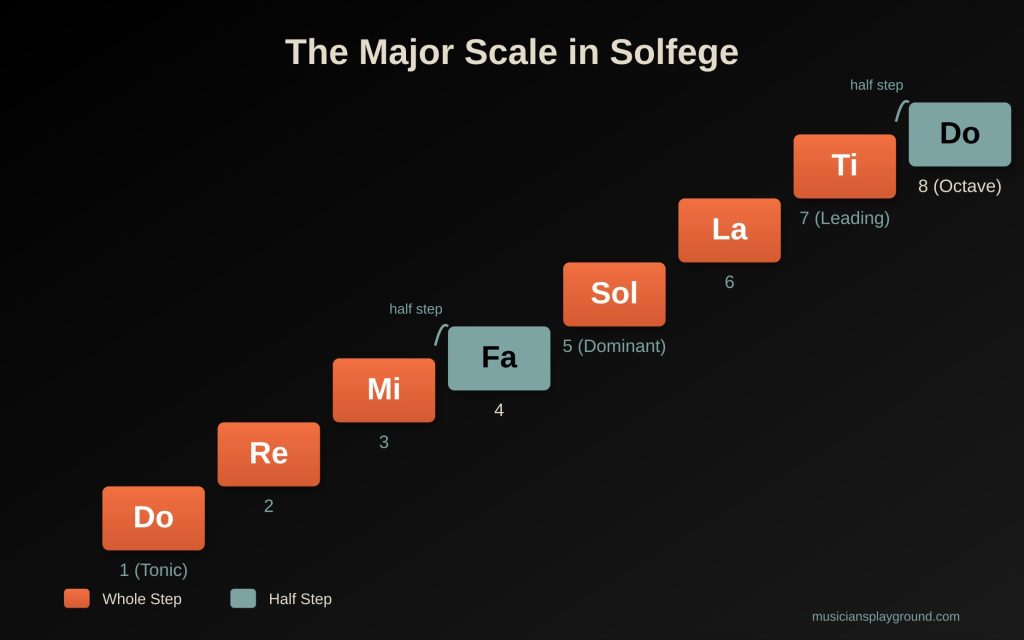
Each solfege syllable represents a specific position in the major scale. Here’s what you need to know about each one.
Do (The Tonic)
Do represents the first note of the scale, called the tonic. This note feels like home base. Every melody eventually wants to return here. When you hear a song end on a satisfying, resolved note, that’s typically Do.
Re (The Supertonic)
Re sits one whole step above Do. It creates a sense of movement away from home. In the key of C major, Re is the note D. This syllable often appears in ascending melodic passages.
Mi (The Mediant)
Mi falls on the third degree of the scale. This note defines whether a scale sounds major or minor. The distance between Do and Mi gives major keys their bright, happy quality. Many memorable melodies emphasize this interval.
Fa (The Subdominant)
Fa sits just a half step above Mi. This close proximity creates a unique tension. In classical music theory, Fa often wants to resolve downward to Mi. You can hear this pull in countless melodies.
Sol (The Dominant)
Sol represents the fifth degree of the scale. After Do, this is the most stable note. The relationship between Do and Sol forms the backbone of Western harmony. When you hear a “V-I” chord progression, you’re hearing the movement from Sol’s chord to Do’s chord.
La (The Submediant)
La sits on the sixth degree. Interestingly, La also serves as the starting point for the natural minor scale. When a melody begins on La and uses the white keys, you get A minor. This dual role makes La particularly important for understanding key relationships.
Ti (The Leading Tone)
Ti creates the most tension of any scale degree. It sits just a half step below Do, desperately wanting to resolve upward. This note drives melodies forward and creates anticipation. When you hear Ti, you expect Do to follow.
Movable Do vs. Fixed Do: Which Solfege System Should You Learn?
Musicians around the world use two different solfege systems. Understanding both helps you appreciate the flexibility of this learning tool.
The Movable Do System
In movable Do solfege, Do always represents the first note of whatever key you’re in. Singing in G major? G is Do. Singing in E-flat major? E-flat is Do. The syllables describe relationships rather than fixed pitches.
This system excels at developing relative pitch. You learn to recognize intervals and scale degrees regardless of the key. Most music education in the United States, United Kingdom, and much of the English-speaking world uses movable Do.
The movable system proves especially useful for singers. Vocalists need to understand how melodies function within keys. They need to feel the pull of Ti toward Do, the stability of Sol, and the brightness of Mi. Movable Do makes these relationships tangible.
The Fixed Do System
Fixed Do takes a different approach. In this system, Do always means C, Re always means D, Mi always means E, and so on. The syllables become alternate names for the notes themselves.
Conservatories across Europe, Asia, and Latin America typically teach fixed Do. Students learn to associate each syllable with an absolute pitch, which can help develop stronger pitch memory.
Instrumentalists sometimes prefer fixed Do. When practicing piano or guitar, having a verbal label for each pitch can reinforce note recognition.
Which System Should You Choose?
For most adult beginners, movable Do offers greater practical benefits. It helps you understand music theory more deeply and transfers easily to any key. You learn to hear
how music works rather than just what notes are being played.
That said, neither system is “right” or “wrong.” Professional musicians have succeeded with both approaches. The best choice depends on your goals and learning environment.
Chromatic Solfege: Adding Sharps and Flats
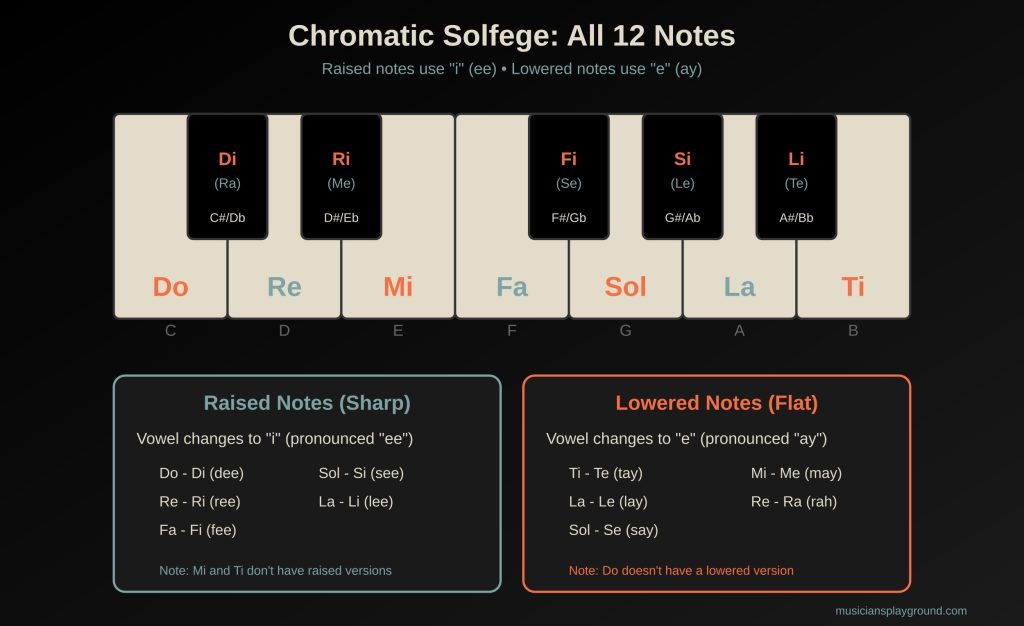
The basic seven syllables cover the major scale. But music rarely stays within one scale. What happens when melodies include sharps and flats?
Chromatic solfege provides syllables for all twelve notes. When a note is raised by a half step, its vowel changes to “i” (pronounced “ee”). When lowered, the vowel changes to “e” (pronounced “ay”).
Here’s how it works with raised notes: Do becomes Di, Re becomes Ri, Fa becomes Fi, Sol becomes Si, and La becomes Li. Notice that Mi and Ti don’t have raised versions because a half step up from Mi is Fa, and a half step up from Ti is Do.
For lowered notes: Ti becomes Te, La becomes Le, Sol becomes Se, Mi becomes Me, and Re becomes Ra. Do doesn’t have a lowered version since a half step down from Do would be Ti.
These chromatic syllables take time to master. Most beginners should focus on the seven basic syllables first. Once those feel comfortable, gradually introduce the chromatic variations.
How Solfege Transforms Your Ear Training
Ear training intimidates many adult beginners. The idea of hearing a note and naming it seems almost magical. Yet solfege makes this skill surprisingly accessible.
When you practice solfege consistently, several things happen in your brain. First, you create strong associations between sounds and syllables. Each syllable becomes linked to a specific sonic quality. Mi starts to “feel” like Mi before you consciously identify it.
Second, you develop what musicians call “audiation.” This means hearing music in your mind before you play or sing it. Solfege gives you an internal voice for this mental music. Instead of vague sounds, you hear specific syllables.
Third, solfege helps you recognize patterns. Musical phrases often use similar melodic shapes across different songs. Once you can identify “Do-Mi-Sol” in one context, you’ll recognize it everywhere. This pattern recognition accelerates your learning dramatically.
Research supports these benefits. Studies have shown that students trained in solfege outperform their peers in melodic dictation, sight-singing, and interval recognition. The method works because it engages multiple learning pathways simultaneously.
Solfege Benefits for Every Instrument
While solfege might seem like a vocal technique, instrumentalists gain tremendous value from it. Here’s how solfege applies to different instruments.
Solfege for Pianists
Piano students often struggle with sight-reading. They can identify notes on the staff but can’t predict how the music should sound. Solfege bridges this gap. When you see a melody moving from the first note of the scale to the third, you know it should sound like “Do-Mi.” This mental soundtrack guides your fingers.
Solfege also helps pianists understand chord progressions. Instead of memorizing chords as abstract shapes, you hear them as combinations of scale degrees. A I-IV-V-I progression becomes Do-Fa-Sol-Do, suddenly making harmonic sense.
Solfege for Guitarists
Guitarists benefit enormously from solfege because the guitar’s layout can be confusing. The same note exists in multiple positions across the fretboard. Solfege cuts through this complexity by focusing on function rather than location.
When you think in solfege, you stop worrying about which fret produces which note. Instead, you focus on the melodic relationships. Whether you’re playing “Mi-Sol-La” on the fifth fret or the tenth fret, the musical relationship remains the same.
This approach proves especially valuable when learning to improvise. Rather than memorizing scale patterns, you learn to hear where the music wants to go. Solfege gives you the vocabulary to describe and reproduce those musical ideas.
Solfege for Singers
For vocalists, solfege is perhaps the most direct training tool available. Singers don’t have frets or keys to help them find pitches. They must produce the correct pitch from their voice alone. Solfege trains the connection between what you hear mentally and what you produce vocally.
Sight-singing, the ability to look at sheet music and sing it correctly, relies heavily on solfege skills. Professional choral singers use solfege to learn new music quickly. They can look at a phrase, identify the solfege syllables, and sing it accurately on the first attempt.
Even if you never plan to sight-sing, solfege improves your pitch accuracy. You develop a clearer internal sense of where each note should land. This precision makes you a more reliable singer in any musical context.
Solfege for Drummers and Percussionists
You might think drummers don’t need solfege since drums typically don’t play pitches. However, understanding melody helps drummers interact better with other musicians. When you know what’s happening harmonically, you can shape your rhythms to complement the music.
Many drummers eventually explore melodic percussion or want to collaborate with other musicians in a band setting. Solfege knowledge makes these transitions smoother. You’ll already understand the language other musicians use to discuss melodies and harmonies.
Practical Solfege Exercises for Adult Beginners
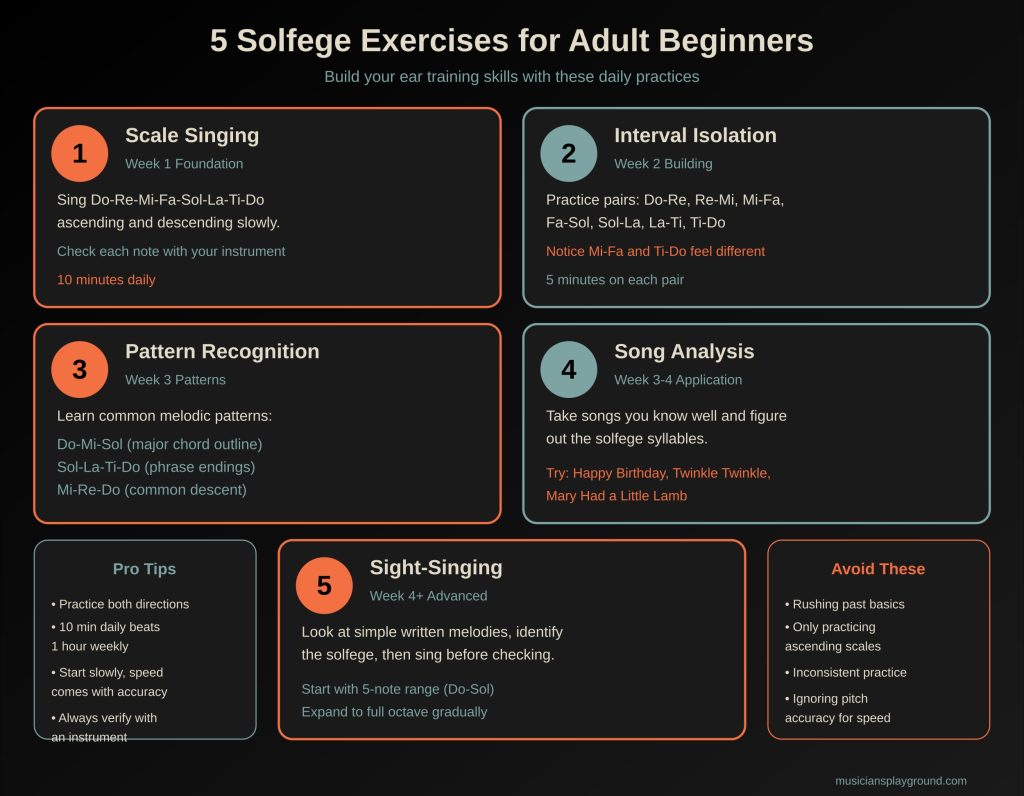
Theory only becomes useful through practice. Here are exercises you can start today, arranged from simplest to more challenging.
Exercise 1: Scale Singing
Begin by singing a major scale using solfege syllables. Play Do on your instrument, then sing Do-Re-Mi-Fa-Sol-La-Ti-Do ascending and descending. Use a piano, guitar, or app to check your pitch accuracy.
Practice this daily for one week before moving on. Speed doesn’t matter. Focus on pitch accuracy and getting comfortable with each syllable. Try different starting notes to prove to yourself that the relationships remain consistent.
Exercise 2: Interval Isolation
Pick two adjacent syllables and practice moving between them. Start with Do-Re. Play Do, sing Do, then sing Re. Check Re on your instrument. Move through all adjacent pairs: Re-Mi, Mi-Fa, Fa-Sol, Sol-La, La-Ti, Ti-Do.
Pay special attention to Mi-Fa and Ti-Do. These half steps feel different from the whole steps. Learning to feel this difference is a crucial ear training skill.
Exercise 3: Pattern Recognition
Learn common melodic patterns and identify them in songs you know. Start with Do-Mi-Sol, which outlines a major chord. Think of the opening notes of “When the Saints Go Marching In” or countless other melodies.
Next, learn Sol-La-Ti-Do, which appears at the end of many phrases. Then try Mi-Re-Do, a common descending pattern. As you learn patterns, you’ll start hearing them everywhere in music.
Exercise 4: Song Analysis
Take a simple melody you know well. “Happy Birthday,” “Mary Had a Little Lamb,” or “Twinkle Twinkle Little Star” all work perfectly. Figure out the solfege syllables for the entire melody.
Write down your analysis, then check it using your instrument. This exercise connects your listening skills with theoretical understanding. It also builds your repertoire of memorized solfege patterns.
Exercise 5: Sight-Singing Practice
Once you’re comfortable with the basic exercises, try sight-singing simple melodies. Find beginner sight-singing books or free online resources. Look at a phrase, identify the solfege, sing it, then check yourself.
Start with melodies that stay within a five-note range (Do through Sol). Gradually expand to full octave melodies. Don’t rush this process. Consistent daily practice matters more than marathon sessions.
Curwen Hand Signs: Adding a Visual Element
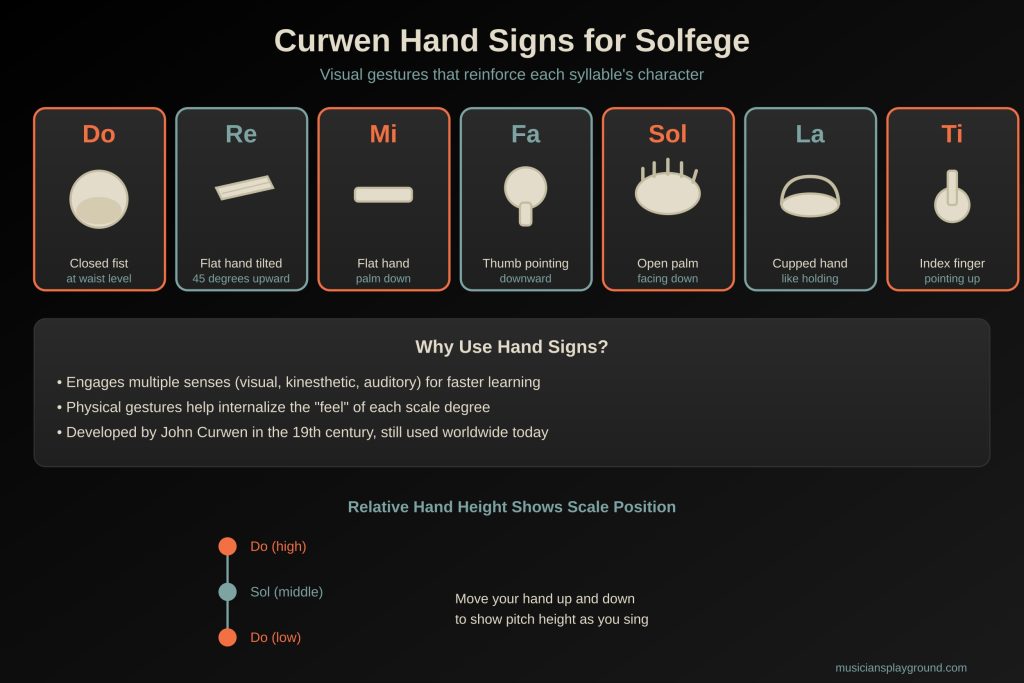
In the 19th century, English minister John Curwen developed hand signs to accompany solfege syllables. Each syllable has a corresponding gesture that reinforces its character and position in the scale.
Do is a closed fist held at waist level, representing stability and groundedness. Re uses a flat hand tilted upward at a 45-degree angle, showing movement away from home. Mi displays a flat hand parallel to the ground, calm and stable.
Fa points the thumb downward from a closed fist, showing the pull back toward Mi. Sol returns to an open palm facing down, the other stable point in the scale. La cups the hand as if holding something precious. Ti points the index finger upward, indicating the pull toward the next Do.
Using hand signs adds a kinesthetic element to your learning. You engage your body, voice, and mind simultaneously. Many music educators believe this multi-sensory approach accelerates learning and improves retention.
Solfege Across Musical Genres
Some adult learners wonder if solfege applies to their preferred musical style. The short answer: absolutely. Solfege describes universal relationships that exist in virtually all Western music and much non-Western music as well.
Solfege in Classical Music
Classical musicians have used solfege for centuries. Conservatory training typically includes rigorous solfege study. The method helps performers internalize complex melodies and navigate challenging key changes.
Solfege in Jazz
Jazz musicians particularly benefit from solfege. Improvisation requires hearing melodies internally before playing them. Solfege provides the vocabulary for this internal musical conversation. Many jazz educators teach solfege as a foundation for
songwriting and improvisation.
Solfege in Pop and Rock
Pop melodies follow the same principles as classical ones. A catchy hook is often memorable because it emphasizes important scale degrees in satisfying ways. Understanding solfege helps you appreciate why certain melodies stick in your head and others don’t.
For musicians interested in
music production, solfege knowledge helps when creating melodies. You can analyze why certain vocal lines work and apply those principles to your own compositions.
Common Solfege Mistakes and How to Avoid Them
Adult learners sometimes develop habits that slow their solfege progress. Here are the most common mistakes and how to correct them.
Mistake 1: Neglecting Pitch Accuracy
Some students focus so much on learning the syllables that they forget to actually match the pitches. Saying the right syllable while singing the wrong note defeats the purpose. Always check your pitch against an instrument.
Mistake 2: Moving Too Quickly
Adults often want to accelerate past beginner exercises. But rushing through foundations creates shaky skills. Spend adequate time on simple scales before tackling complex melodies. Solid basics enable rapid progress later.
Mistake 3: Practicing Inconsistently
Ten minutes daily beats one hour weekly. Solfege skills develop through consistent repetition. Your brain needs regular exposure to strengthen the connections between sounds and syllables. Set a daily practice reminder.
Mistake 4: Only Practicing Ascending Patterns
Many students practice scales going up but neglect coming down. Real music moves in both directions constantly. Practice descending patterns as frequently as ascending ones.
Mistake 5: Ignoring the Minor Scale
Major scales are important, but minor scales appear constantly in music. Learn to apply solfege to minor keys as well. In movable Do, minor scales typically start on La (La-Ti-Do-Re-Mi-Fa-Sol-La). Some systems use a modified approach where minor keys start on Do with a lowered third.
Why It’s Never Too Late to Learn Solfege

Some adults believe that ear training is only for young children or professional musicians. This simply isn’t true. Research consistently shows that adults can develop strong relative pitch skills at any age.
Adult brains actually have certain advantages for learning solfege. You can understand theoretical concepts more quickly. You have more patience for systematic practice. You can connect musical ideas to your broader life experience.
Many successful musicians began their ear training as adults. Leonard Bernstein didn’t start serious music study until his teens. Andrea Bocelli was an adult when he transitioned from amateur to professional singing. Your starting age matters far less than your commitment to consistent practice.
The key is embracing the journey. Solfege skills develop gradually. You won’t master them overnight, and that’s perfectly fine. Each practice session builds on the last. Trust the process and celebrate small improvements.
Getting Started with Solfege Training
Ready to begin your solfege journey? Here’s a practical roadmap for your first month.
Week One: Focus exclusively on singing major scales with solfege. Practice ascending and descending, slowly and accurately. Aim for ten minutes daily.
Week Two: Add interval exercises. Practice moving between adjacent syllables, then try skipping one note (Do to Mi, Re to Fa, etc.). Continue scale practice.
Week Three: Begin analyzing simple songs. Pick three to five melodies you know well and figure out their solfege. Write down your analysis.
Week Four: Try sight-singing simple exercises. Find beginner resources online or in music stores. Compare your singing to the correct pitches.
After this foundation month, consider working with a qualified instructor. A teacher can identify issues you might miss, provide personalized exercises, and keep you motivated through challenging phases.
At Musicians Playground, our instructors incorporate ear training into voice lessons and instrument instruction. Whether you’re learning piano, guitar, or any other instrument, solfege can become part of your musical development.
Transform Your Musical Ear with Solfege
Solfege has survived for over a thousand years because it works. This elegant system transforms abstract sounds into nameable, learnable elements. Whether you’re a complete beginner or returning to music after decades away, solfege offers a clear path to stronger musicianship.
The syllables Do-Re-Mi-Fa-Sol-La-Ti aren’t just memorable sounds from a movie. They’re powerful tools that connect your ear to your voice, your voice to your instrument, and your instrument to your musical understanding.
Start today. Sing a scale. Name the notes. Begin building your musical vocabulary. Your future self will thank you for every minute you invest in this foundational skill.
Ready to develop your ear with expert guidance? Our instructors in downtown Boston help busy adults unlock their musical potential through proven techniques including solfege. Whether you’re interested in
singing lessons, piano lessons, or guitar lessons, we’ll help you hear music in a completely new way.