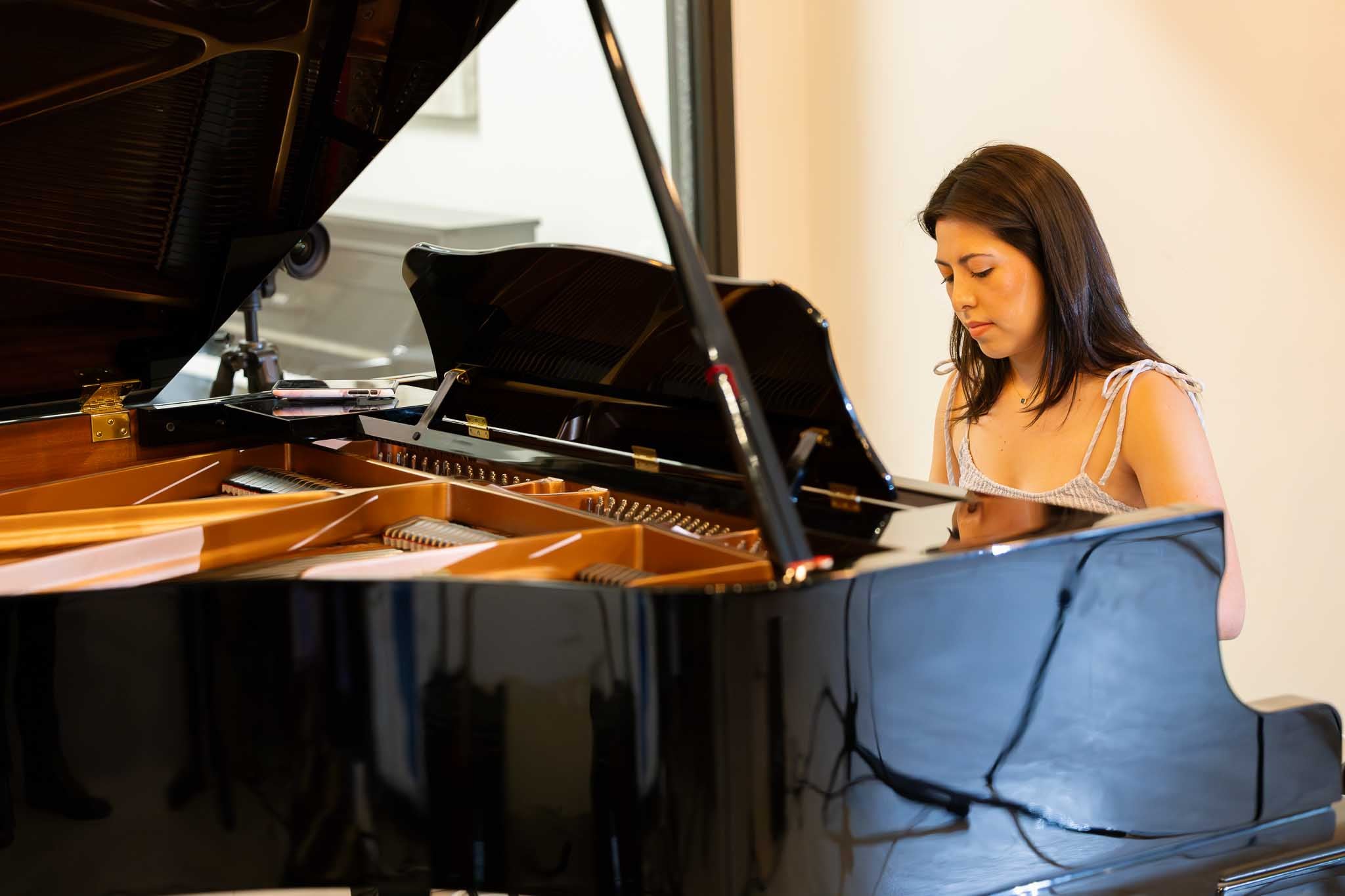
Jazz Piano Improvisation: The Surprisingly Simple C Major Method
Updated August 8, 2026
Introduction
There’s a moment every adult piano student dreams about, sitting down at the keys, hearing a simple chord progression, and creating music on the spot. No sheet music. No memorized pieces. Just you, the piano, and pure musical expression.
Jazz piano improvisation might sound intimidating, but here’s the truth: if you can play a C major scale, you already have everything you need to start improvising. The C major scale is the perfect launching pad because it uses only white keys, letting you focus entirely on the feel of improvisation rather than getting tangled up in sharps and flats.
This guide walks you through exactly how to transform that simple seven-note scale into expressive jazz improvisation, step by step, technique by technique.
What You’ll Need Before You Start
Before diving into improvisation, make sure you’re comfortable with these fundamentals:
- Playing the C major scale (C-D-E-F-G-A-B-C) with both hands
- Basic understanding of piano fingering (1-2-3-1-2-3-4-5 for the right hand ascending)
- Familiarity with simple chord shapes (C major, F major, G major triads)
Don’t worry if you’re still building these skills. Many adult students find that working on improvisation actually strengthens their technical foundation because it requires truly understanding where notes live on the keyboard.
Understanding the C Major Scale for Jazz Improvisation
The Seven Notes and Their Roles
In jazz, each note in the C major scale has a specific character and function:
| Scale Degree | Note | Jazz Character |
|---|---|---|
| 1 (Root) | C | Home base, stable and resolved |
| 2 | D | Gentle tension, wants to move |
| 3 | E | Sweet, defines the major sound |
| 4 | F | Creates tension over C major chord |
| 5 | G | Strong, stable, supportive |
| 6 | A | Warm, sophisticated color |
| 7 | B | Strong pull toward the root |
Understanding these roles helps you make intentional choices when improvising. Landing on C or G creates stability. Lingering on B creates anticipation. Playing around with E gives your improvisation that distinctly major, uplifting quality.
Why C Major Is Perfect for Learning Jazz Improvisation
Jazz pianists often start with C major for several practical reasons. The all-white-key layout means you can watch your hands less and listen more. You can focus entirely on rhythm, phrasing, and expression without worrying about hitting wrong notes. And perhaps most importantly, C major lets you build confidence before tackling more complex keys.
Step-by-Step: Your First Jazz Piano Improvisation
Step 1: Establish the Groove with Your Left Hand
Before your right hand plays a single improvised note, your left hand needs to lay down the harmonic foundation. Start with this simple pattern:
Basic Left Hand Voicing:
- Play C and G together (a fifth) on beats 1 and 3
- Keep it steady and relaxed
- Count “1-2-3-4” out loud while playing
This creates the “bed” your right hand will improvise over. The consistency of your left hand gives your right hand freedom to explore.
Step 2: Start with Just Three Notes
Here’s where most piano improvisation guides go wrong. They throw the entire scale at you immediately. Instead, limit yourself to just C, D, and E at first.
Exercise: The Three-Note Exploration
- Keep your left hand playing the C-G pattern
- With your right hand, play only C, D, and E
- Mix them up in any order
- Focus on rhythm. Try long notes, short notes, rests
- Practice for 2-3 minutes without stopping
This limitation sounds counterintuitive, but it forces you to be creative with rhythm and phrasing rather than relying on running up and down the scale.
Step 3: Add Rhythmic Variety
Jazz lives in its rhythm. Take those three notes and experiment with these rhythmic concepts:
Syncopation: Play notes between the beats rather than on them. If your left hand plays on 1 and 3, try playing right-hand notes on 2 and 4, or on the “and” of each beat.
Space: Leave gaps in your playing. Some of the most powerful moments in jazz improvisation are the silences. Let a note ring, take a breath, then continue.
Repetition: Jazz improvisers often repeat short melodic ideas (called “motifs”) with slight variations. Play C-D-E, then try E-D-C, then C-E-D.
Step 4: Expand to the Full Scale
Once three notes feel natural, gradually add more:
- Week 1: C, D, E only
- Week 2: Add G and A (the “safe” notes)
- Week 3: Add F and B (the “tension” notes)
- Week 4: Full scale with intentional note choices
This gradual expansion ensures you’re always in control of your improvisation rather than randomly hitting keys.
Essential Jazz Piano Techniques for C Major Improvisation
Target Notes and Resolution
In jazz, not all notes are equal. Some notes sound great held over a chord; others want to move. Over a C major chord, your strongest “target notes” are C, E, and G (the chord tones).
Exercise: Target Note Practice
- Play a C major chord in your left hand
- Improvise in your right hand, but always land on C, E, or G on beat 1 of each measure
- Use D, F, A, and B as “passing tones” to connect your target notes
This technique gives your improvisation direction and prevents the “noodling” sound that frustrates many beginners.
The Pentatonic Shortcut
If the full seven-note scale feels overwhelming, try the C major pentatonic scale: C-D-E-G-A. These five notes eliminate the two most tension-filled notes (F and B), making it nearly impossible to play a “wrong” note.
Many professional jazz pianists use pentatonic scales as their foundation, adding chromatic notes and tensions as embellishments. Starting here isn’t cheating, it’s smart practice.
Call and Response Phrasing
Think of your improvisation as a conversation. Play a short phrase (the “call”), leave space, then play a responding phrase (the “response”).
Example Pattern:
- Call: C-D-E (ascending)
- Rest: Two beats of silence
- Response: E-D-C (descending answer)
This conversational approach creates natural musicality and helps you avoid the common beginner mistake of playing continuous streams of notes.
Common Mistakes Adult Piano Students Make When Learning Jazz Improvisation
Playing Too Many Notes
The instinct to fill every moment with sound is strong, but restraint is what separates musical improvisation from random playing. Challenge yourself: can you make two notes sound interesting for four measures?
Ignoring the Left Hand
Your left hand isn’t just accompaniment, it’s the rhythmic and harmonic engine of your improvisation. Spend equal practice time developing left-hand patterns as you do right-hand melodies.
Practicing Without a Steady Pulse
Jazz improvisation requires rock-solid internal timing. Always practice with a metronome or backing track. Start slow (60-70 BPM) and resist the urge to speed up before you’re ready.
Expecting Perfection Immediately
Improvisation is a skill that develops over months and years, not days. Every jazz great played thousands of hours of imperfect improvisations before finding their voice. Embrace the messy middle.
Practice Routine: Your First Month of Jazz Piano Improvisation
Week 1: Foundation Building
- 5 minutes: C major scale warm-up (both hands, separate and together)
- 10 minutes: Left-hand chord pattern practice (C-G voicing, steady rhythm)
- 10 minutes: Three-note improvisation (C, D, E only)
Week 2: Rhythmic Development
- 5 minutes: Scale warm-up with varied rhythms
- 10 minutes: Left-hand pattern with syncopation experiments
- 10 minutes: Three-note improvisation focusing on space and silence
Week 3: Scale Expansion
- 5 minutes: Pentatonic scale warm-up (C-D-E-G-A)
- 10 minutes: Target note exercises
- 10 minutes: Five-note improvisation with call and response
Week 4: Integration
- 5 minutes: Full C major scale warm-up
- 10 minutes: Left-hand pattern with different voicings
- 10 minutes: Full-scale improvisation with intentional phrase structure
Taking Your Jazz Piano Improvisation Further
Once you’re comfortable improvising over C major, the jazz world opens up significantly. Your next steps might include:
Learning Common Jazz Chord Progressions: The ii-V-I progression (Dm7-G7-Cmaj7 in the key of C) is the foundation of countless jazz standards.
Exploring Modes: The C major scale contains seven modes, each with a unique sound. D Dorian and G Mixolydian are particularly common in jazz.
Adding Blue Notes: Introducing the “flat 3” (Eb) and “flat 7” (Bb) into your C major improvisations adds authentic blues flavor.
Transcribing Jazz Pianists: Listening to and learning solos from pianists like Bill Evans, Herbie Hancock, or Oscar Peterson shows you how masters use these same tools.
Why Learning Jazz Improvisation as an Adult Is Easier Than You Think
Adult learners bring something to piano that children often lack: life experience. You understand concepts like tension and release because you’ve felt them. You can grasp music theory more quickly because you’ve developed analytical thinking skills. And you have clear motivation, you’re learning because you genuinely want to, not because someone told you to practice.
Research from the field of adult learning consistently shows that motivated adult students often progress faster than children in skill development, particularly when learning builds on conceptual understanding rather than rote memorization. Jazz improvisation, with its emphasis on understanding how music works rather than just reading notes, aligns perfectly with adult learning strengths.
Start Your Jazz Piano Journey in Boston
Learning jazz piano improvisation transforms your relationship with music. Instead of reproducing what others have written, you become a creator, expressing your own musical ideas in real time.
At Musicians Playground in downtown Boston, our adult piano lessons are designed specifically for working professionals who want more than just playing scales. Our working Boston musicians understand that adult students have unique goals, schedules, and learning styles.
Whether you’re a complete beginner or a returning player ready to explore jazz for the first time, we’ll meet you exactly where you are and help you develop the skills to improvise confidently.
Ready to play your first jazz improvisation? Book a trial lesson and discover what it feels like to make music that’s entirely your own.
Frequently Asked Questions
How long does it take to learn jazz piano improvisation?
Most adult students can play basic improvisations within 2-3 months of focused practice. Developing a personal style and comfort with complex progressions typically takes 1-2 years. The key is consistent practice, even 15-20 minutes daily produces significant results.
Do I need to read music to improvise on piano?
No. While music literacy is valuable, jazz improvisation primarily requires ear training, chord knowledge, and understanding of scale relationships. Many accomplished jazz pianists learned primarily by ear and through playing with other musicians.
Is C major the best key for learning jazz improvisation?
C major is ideal for beginners because of its all-white-key simplicity. However, jazz musicians need to eventually improvise in all 12 keys. F major and G major are natural next steps after mastering C major.
Can I learn jazz piano improvisation without a teacher?
Self-study is possible with the right resources, but a skilled teacher dramatically accelerates progress. Jazz improvisation involves nuances of rhythm, touch, and phrasing that are difficult to develop without personalized feedback.
What’s the difference between jazz improvisation and classical piano?
Classical piano typically involves performing written compositions exactly as notated. Jazz piano emphasizes creating new melodic ideas over chord progressions in real time. Both require technical skill, but jazz prioritizes spontaneous creativity while classical focuses on interpretive precision.
How much piano experience do I need before learning jazz improvisation?
Students with 6-12 months of basic piano experience, comfortable with scales and simple chords, are typically ready to begin jazz improvisation study. Complete beginners can start learning jazz concepts early, though building basic keyboard familiarity first makes the process smoother.