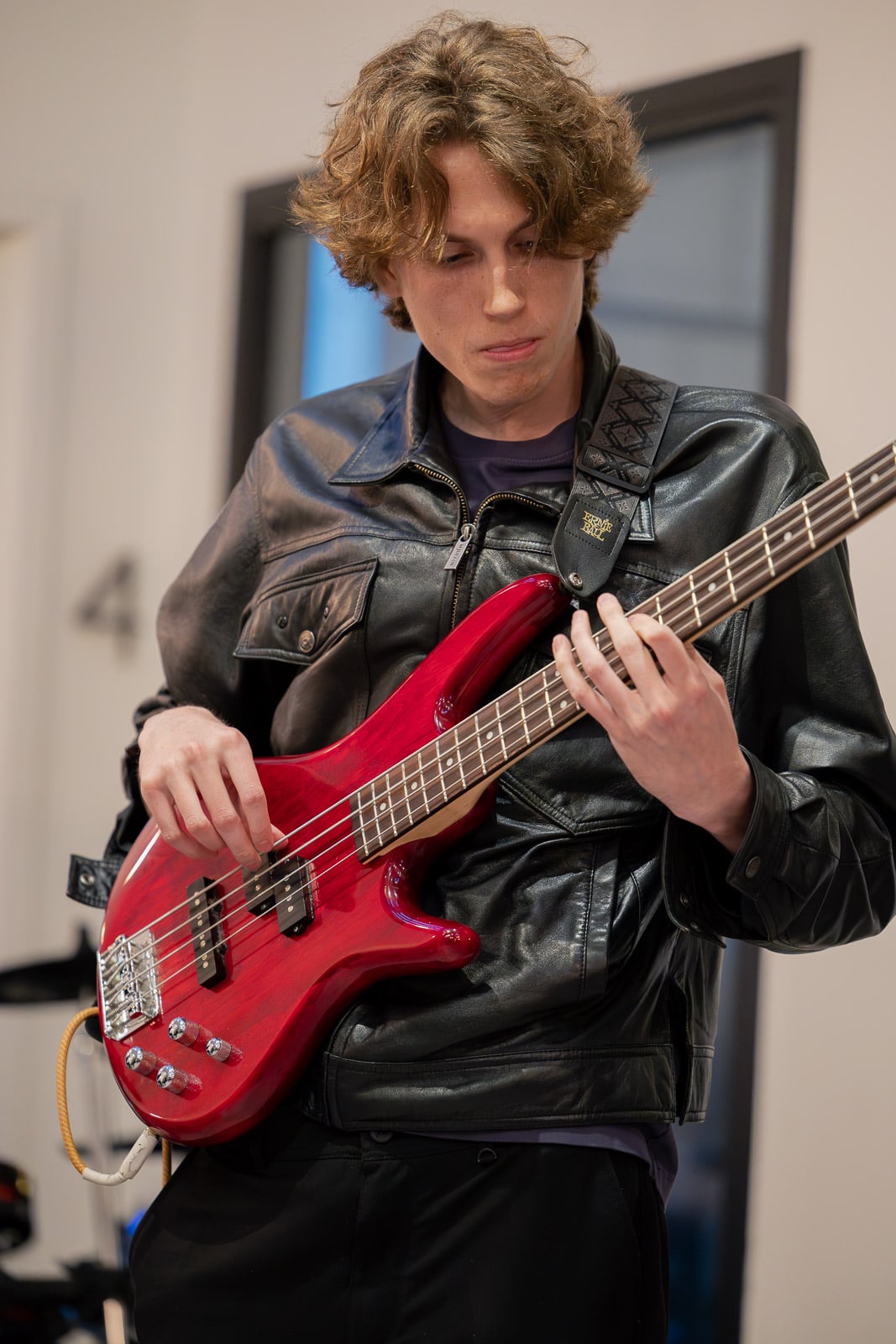
How to Hold a Bass Guitar: Posture, Grip & Setup for Adults
Updated August 25, 2026
Picking up a bass guitar for the first time as an adult is a thrill. However, almost every new student does the same thing within ten minutes: they tense up. Their shoulders climb toward their ears, their wrists bend at unhealthy angles, and they start fighting the instrument. As a result, learning how to hold a bass guitar properly is the single most important thing you can do in your first month of playing.
Good posture isn’t just about looking professional. In fact, your hand position determines how easily you can reach notes, how fast you can play, and whether you’ll still want to play three months from now. Therefore, this guide walks you through everything you need to set yourself up for a comfortable, sustainable bass playing journey.

Why How You Hold a Bass Guitar Matters
A bass guitar is heavier than an electric guitar. Furthermore, the scale length, the distance between the nut and the bridge, is longer. Consequently, small mistakes in how you hold the instrument compound quickly. A slightly tilted neck might feel fine for ten minutes, but after a 45-minute lesson, your wrist hurts and your forearm aches.
Adult learners deal with this more than kids do. We have desk jobs, we sit at computers, and we already carry tension in our shoulders and necks. As a result, picking up bad bass posture habits will absolutely affect the rest of your week. Therefore, building good posture from day one is essential.
What good bass posture protects
Proper posture protects three things. First, it protects your fretting hand wrist from chronic strain. Second, it protects your shoulder and neck from the weight of the instrument. Third, it protects your back from the awkward leaning many beginners do when they can’t see the fretboard.
At Musicians Playground, every adult student begins with a posture assessment. Furthermore, our working Boston musicians check posture at the start of every lesson for the first three months. The reason is simple. You can fix bad habits early, but unlearning them after a year is much harder.
Sitting vs. Standing: How to Hold a Bass Guitar at Home
Most adult bass students practice sitting down. However, you’ll need to be comfortable standing too, because that’s how you’ll play in any band setting. Therefore, you should practice both positions from your first month.
The seated position
Sit on the front third of a chair without arms. Your feet should be flat on the floor. Place the curve of the bass body on your right thigh if you’re right-handed, or your left thigh if you’re left-handed. The bass should rest at roughly a 15 to 20 degree angle, with the headstock pointing slightly upward.
Keep your back straight but not rigid. Additionally, your fretting arm should hang naturally without your shoulder hiking up. If your shoulder is rising, your strap or your seat height is wrong.
The standing position
For standing, you’ll need a strap. Adjust the strap so the bass sits at the same height as it does when you’re seated. As a result, your muscle memory transfers between positions. Many beginners wear the bass too low because it looks cool. However, this destroys your wrist over time.
Your fretting hand thumb should be able to rest on the back of the neck without your wrist bending more than 30 degrees. If you have to bend your wrist hard to reach the strings, raise the strap.
Strap Height: The Most Important Setup Decision
Strap height matters more than almost anything else when learning how to hold a bass guitar. In fact, most chronic bass injuries trace back to a strap that’s too low.
Where to set your strap
Stand up with your bass on. The middle of the body should sit roughly at your belly button or just above. Furthermore, when you bring your fretting hand to the bass, your wrist should remain mostly straight. If your wrist is angled sharply downward, raise the strap.
You’ll see professional bass players wearing the bass low. Some can pull this off because they’ve trained for years. However, you’re not one of those players yet. Therefore, set the strap at a comfortable height and worry about looks later.
Strap material matters
A wide leather or padded nylon strap distributes the weight better than a thin guitar strap. Bass guitars typically weigh 8 to 10 pounds. Consequently, a thin strap will dig into your shoulder during a 45-minute lesson. Therefore, invest in a 2.5 to 3 inch wide padded strap from the start.
Fretting Hand Position: Where Most Adults Go Wrong
Your fretting hand, the one on the neck, does most of the technical work in bass playing. Therefore, getting this hand right is critical.
The thumb behind the neck
Your thumb should rest on the back of the bass neck, roughly behind the second or third finger. Specifically, the pad of your thumb makes contact, not the joint. Furthermore, your thumb should never wrap around to the top of the neck for bass playing. This is a guitar habit that doesn’t translate to bass.
If your thumb keeps creeping up over the top, your bass is probably too low. As a result, raise the strap and the thumb will naturally fall into place.
Curved fingers, light touch
Your fretting fingers should curve naturally, like you’re holding a small ball. Press the strings just hard enough to make a clear note, and no harder. In fact, beginners almost universally press too hard. Consequently, their fingers cramp and their forearms ache.
Test it: press a string just barely until the note rings clear, then back off slightly until it buzzes, then add just enough pressure to clean it up. That’s your target.
One finger per fret
For most beginner playing, you’ll use a “one finger per fret” approach in the lower frets. In other words, your index finger handles fret one, your middle finger fret two, your ring finger fret three, and your pinky fret four. This builds finger independence and makes scales much easier later.
Plucking Hand Position
Your plucking hand, the one over the body of the bass, has more options than your fretting hand. Most adult beginners start with finger-style plucking, which uses the index and middle fingers alternately.
Where to anchor your thumb
Your plucking hand thumb anchors on the pickup or on a thumb rest. Specifically, when playing the E string (the thickest string), your thumb sits on the pickup. When you move to higher strings, your thumb floats up to mute the strings below. This is called “floating thumb” technique.
Floating thumb takes a few weeks to feel natural. However, it’s worth learning early because it solves the muting problem that haunts new bass players.
Plucking depth
Pluck the strings about an inch from where they meet the pickup. Furthermore, pluck across the string, not down into it. Your finger should follow through and rest on the next string. As a result, you get a cleaner tone and you mute the higher string at the same time.
Common Posture Mistakes Adult Beginners Make
Here are the most frequent posture problems we see in our adult bass students. If you recognize yourself in any of these, fixing them now will save you months of bad habits.
Mistake 1: Looking down at the fretboard
Beginners want to see what their fingers are doing. However, hunching over the bass to look at the fretboard creates serious neck strain. Therefore, learn to feel the frets rather than see them. Use the fret markers (the dots on the side of the neck) for orientation.
Mistake 2: Squeezing the neck
Adults under stress squeeze. Consequently, the bass neck takes the brunt of work-week tension. If your fretting hand is exhausted after ten minutes, you’re squeezing too hard. Take a breath, drop your shoulders, and use the lightest possible pressure.
Mistake 3: A bass that’s too heavy
If you’re shopping for your first bass, weight matters. A 10-pound bass on a thin strap is miserable. As a result, look for instruments in the 7 to 9 pound range, and try them on at the store before buying. We can help you choose your first bass during your bass guitar lessons with us.
Mistake 4: Practicing on the couch
Slouching on a couch with a bass in your lap might feel cozy. However, it ruins your fretting wrist angle. Consequently, practice in a proper chair, on a piano bench, or stand up.
How Bass Posture Connects to the Rest of Your Playing
Good posture isn’t just about comfort. In fact, it directly affects your tone, your speed, and your endurance. A relaxed plucking hand produces warmer tone. A relaxed fretting hand plays scales faster. Furthermore, good posture means you can practice longer without fatigue, which means you progress faster.
This is one reason private bass instruction matters. Your instructor watches things you can’t see, the angle of your wrist, the lift of your shoulder, the tension in your forearm. Therefore, regular feedback from a professionally performing teacher fixes problems before they become permanent.
Setting Up Your Practice Space at Home
Where you practice matters as much as how. Consequently, here’s what to set up at home.
A dedicated practice chair
Use a chair without arms. The seat height should let your feet rest flat on the floor with your knees at 90 degrees. A piano bench works perfectly. As a result, you’ll have consistent posture every session.
A stand for your bass
Keep your bass on a stand, not in a case. The friction of taking it out of a case is the #1 reason adult learners skip practice. In fact, if your bass is visible and ready to play, you’ll pick it up casually throughout the day. Furthermore, those five-minute pickup sessions add up faster than people expect.
A small amp or headphone rig
You need to hear yourself clearly. A small practice amp or a headphone amp lets you check your tone and notice mistakes. Therefore, make sure your home setup includes a way to actually hear what you’re playing.
What to Expect in Your First Bass Guitar Lesson
If you join Musicians Playground for adult bass guitar lessons, your first session will spend significant time on posture and setup. Specifically, your instructor will assess your seated and standing positions, adjust your strap, and check your hand angles. As a result, you’ll leave that first lesson with a body memory of what good posture feels like.
Furthermore, in our group classes, you’ll watch other adult students play. This visual learning helps you internalize good posture faster than reading about it. The combination of private feedback and group observation is one reason our students develop strong fundamentals quickly.
Frequently Asked Questions
Should I sit or stand to practice bass?
Practice both. Sitting is easier when you’re learning new material. However, standing is how you’ll actually play in any band situation. Therefore, alternate between the two during your practice sessions.
How tight should my bass strap be?
The strap should hold the bass in place without you supporting it with your hands. In other words, you should be able to let go of the bass entirely while standing, and it should sit at the same height as when you were holding it.
Why does my back hurt after playing bass?
Three likely culprits: a strap that’s too low, slouching to see the fretboard, or a bass that’s too heavy. Fix the strap first, then your posture, then consider a lighter instrument.
How long should my first practice sessions be?
Start with 15 to 20 minutes daily. Adults in our school progress faster with five 20-minute sessions per week than two long sessions on the weekend. Furthermore, shorter sessions reduce the risk of building tension into your playing.
Ready to Get Your Bass Posture Right from Day One?
Learning how to hold a bass guitar correctly is the foundation of every other technique you’ll learn. Therefore, get this right early. At Musicians Playground, every adult bass student starts with hands-on posture coaching from a professionally performing instructor. Furthermore, our adult-only studio in Downtown Crossing is built specifically for working professionals who want to learn the right way.
If you’re ready to start, our $100 Intro Week gives you private lessons, group classes, and full studio access for seven days. As a result, you can experience exactly what professional-level instruction feels like before committing. To explore the full bass guitar journey, read our complete guide to bass guitar lessons in Boston. Your wrists, your shoulders, and your future self will thank you.